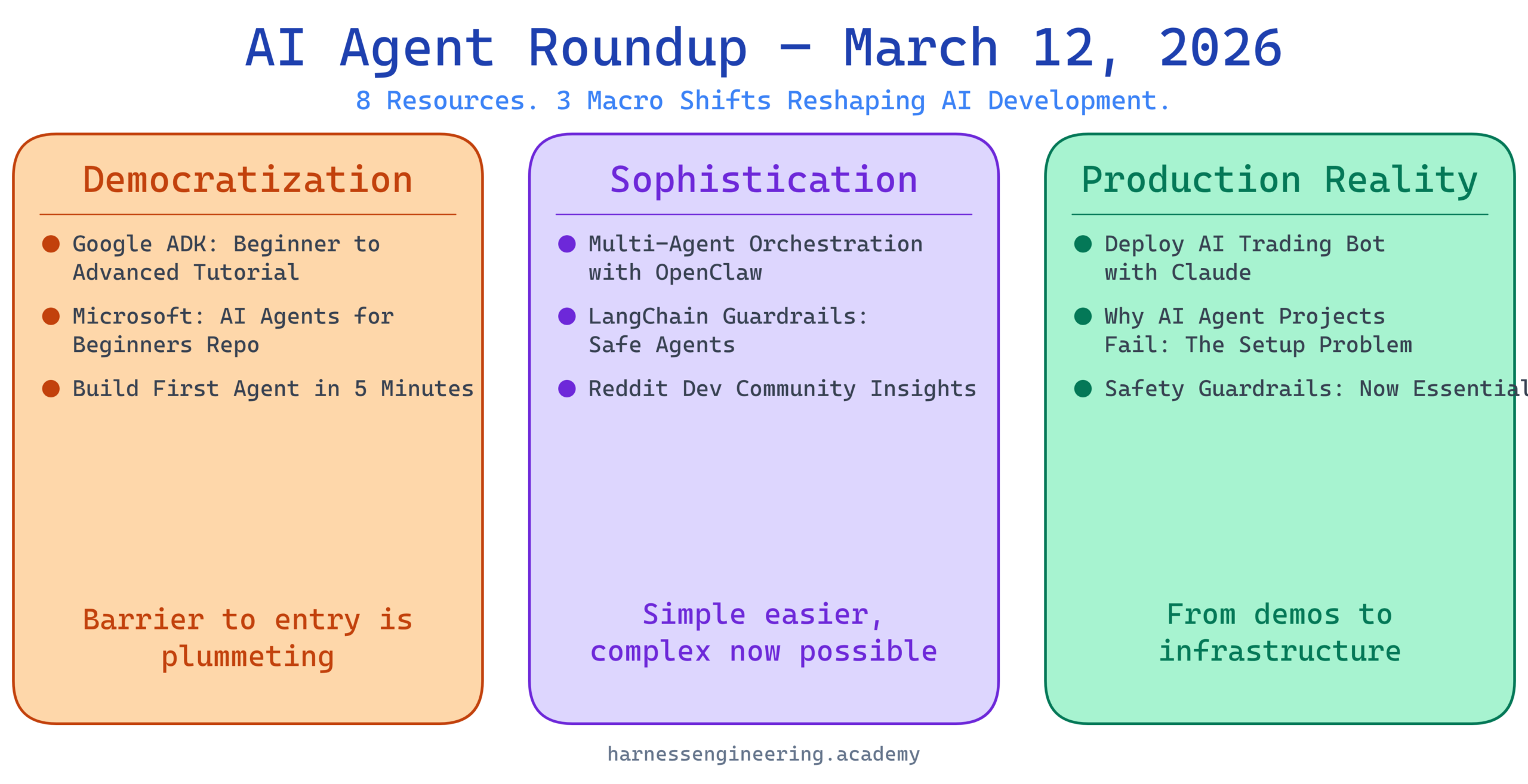
The AI agent development landscape continues to accelerate, with major players like Google and Microsoft doubling down on educational resources and developer tooling. This week’s roundup reveals a clear trend: the barriers to entry for building AI agents are plummeting, while the sophistication of available frameworks is simultaneously increasing. From beginner-friendly tutorials to enterprise-grade orchestration systems, developers now have access to an unprecedented toolkit for autonomous agent development.
1. Google ADK Tutorial: Build AI Agents & Workflows from Scratch (Beginner to Advanced)
Google’s comprehensive ADK tutorial provides a complete pathway from foundational concepts through advanced implementation techniques for building AI agents and workflows. This resource bridges the gap between theoretical understanding and practical execution, making it invaluable for developers at all experience levels.
Analysis: Google’s investment in educational content around the ADK signals the company’s commitment to democratizing AI agent development. By providing tutorials spanning beginner to advanced levels, Google is positioning itself as the go-to resource for developers looking to leverage its infrastructure. This move also suggests that Google sees significant market potential in the agentic AI space and is building a developer ecosystem around it.
2. Microsoft’s ai-agents-for-beginners Repository
Microsoft’s GitHub repository offers structured, lesson-based learning for anyone entering the AI agent field. The repository combines theoretical foundations with hands-on exercises, creating a cohesive learning path for newcomers. This initiative reflects Microsoft’s broader strategy to establish Copilot and Azure AI as central to enterprise automation.
Analysis: Microsoft’s commitment to beginner-friendly education is particularly strategic given their integration of AI agents into enterprise products. By lowering the barrier to entry, Microsoft cultivates a developer base fluent in their AI tools. This approach also positions Azure AI as more accessible than competitors, potentially driving adoption rates among organizations evaluating AI agent platforms.
3. Build Your First AI Agent in 5 Minutes | Agentic AI Course
This rapid-fire Python tutorial delivers immediate gratification for developers eager to see tangible results. By distilling core concepts into a five-minute build, the creator eliminates analysis paralysis and accelerates the learning curve for newcomers. The quick-start format resonates with developers who prefer learning through hands-on experimentation.
Analysis: The popularity of ultra-condensed tutorials reflects shifting learning preferences in the developer community. Rather than comprehensive multi-hour courses, developers increasingly seek “minimal viable understanding”—just enough knowledge to build something functional. This trend suggests that AI agent development is maturing: core patterns are becoming standardized enough to teach in bite-sized formats, analogous to how web development tutorials have evolved.
4. Deploy Your Own AI Agent Trading Bot Using Claude Full Tutorial
This comprehensive guide walks developers through building and deploying an autonomous trading bot powered by Claude. The tutorial covers the full deployment lifecycle, from agent design through market integration. This real-world use case demonstrates the practical viability of agentic AI in financial contexts.
Analysis: Trading bot development has become a bellwether application for AI agents because it offers immediate feedback (profit/loss) and high motivation for builders. The emergence of accessible tutorials in this space suggests AI agents have matured beyond proof-of-concepts into genuinely deployable systems. However, the risks inherent in financial applications also underscore the growing importance of governance frameworks and safety measures—topics that will likely dominate this space as adoption accelerates.
5. Multi Agent Orchestration with OpenClaw
This tutorial on OpenClaw orchestration addresses a critical challenge in advanced agent development: coordinating multiple autonomous systems working toward shared objectives. As organizations deploy multiple specialized agents, orchestration becomes a crucial differentiator between chaos and coordination. Understanding these patterns is essential for scaling beyond single-agent systems.
Analysis: Multi-agent orchestration represents the next frontier in AI agent maturity. While single-agent systems are becoming commoditized through easy-to-use frameworks, the ability to compose multiple agents into coherent systems remains a competitive advantage. Teams adopting orchestration frameworks now will build institutional knowledge that’s difficult to replicate, positioning them favorably as multi-agent systems become industry standard.
6. Learning and Building AI Agents (Community Discussion)
This Reddit discussion captures the practical concerns and learning strategies of developers actively building in this space. The community-sourced perspectives highlight the gap between theoretical knowledge and production-ready implementations, revealing where friction points exist in the development workflow.
Analysis: Community forums like Reddit are invaluable for understanding real-world pain points that official documentation often glosses over. The collective experience in these discussions suggests that while frameworks are improving, developers still struggle with the human aspects of agent development: prompt engineering, data pipeline management, and production reliability. This indicates significant opportunity for specialized tools and platforms that abstract these complexities away.
7. Guardrails with LangChain: Build Safe AI Agents Like a Pro
This LangChain crash course prioritizes a critical but often overlooked aspect of agent development: safety and guardrails. As AI agents gain autonomy, implementing robust safety measures becomes non-negotiable. LangChain’s emphasis on guardrails reflects an industry-wide shift toward responsible AI development.
Analysis: Safety guardrails are evolving from optional nice-to-haves to essential components of production agents. Regulatory pressure, liability concerns, and high-profile AI failures have made safety central to the design conversation. Teams that integrate guardrail thinking early in development will avoid costly retrofits later. This also suggests that future hiring and promotion in AI teams will increasingly reward those who prioritize safety alongside performance.
8. Why AI Agent Projects Fail: The Setup Problem
This instructional video diagnoses a fundamental truth in AI agent development: most failures aren’t due to model limitations but inadequate foundational setup. Whether it’s tool integration, data pipelines, or state management, flawed infrastructure dooms otherwise promising projects. Understanding these failure modes is crucial for anyone building AI agents at scale.
Analysis: This perspective is invaluable because it shifts focus from the model (often the most hyped component) to often-invisible infrastructure. It suggests that successful AI agent teams will be those that treat engineering fundamentals—testing, monitoring, infrastructure, documentation—with the same rigor as the AI logic itself. This is a maturation moment: the field is moving past the “build a fun demo” phase into “build systems that work reliably in production.”
Key Takeaways
Three macro themes emerge from this week’s AI agent news:
1. Democratization Accelerating: Major tech companies are investing heavily in educational content, making AI agent development accessible to junior developers and expanding the talent pool. This arms race for developers suggests fierce competition ahead as companies race to own the AI agent platform stack.
2. Sophistication Meeting Accessibility: While frameworks become easier to use, the field simultaneously advances toward multi-agent orchestration and enterprise-grade safety. This creates a barbell effect: simple things are getting simpler, and complex things are becoming possible, but the middle gets compressed.
3. Production Reality Settling In: The transition from experimental to production-focused content reflects market maturation. Discussions increasingly center on reliability, safety, and operational concerns rather than pure capability. This suggests we’re entering a phase where AI agents graduate from research curiosities to infrastructure components.
For developers, the message is clear: now is the time to build foundational skills in AI agent development. The barrier to entry is lower than ever, frameworks are stabilizing, and real-world applications are demonstrating tangible value. However, long-term success requires moving beyond tutorials to deep understanding of system design, safety practices, and production operations.
This roundup covers resources published as of March 12, 2026. Links and resources are current as of publication date.