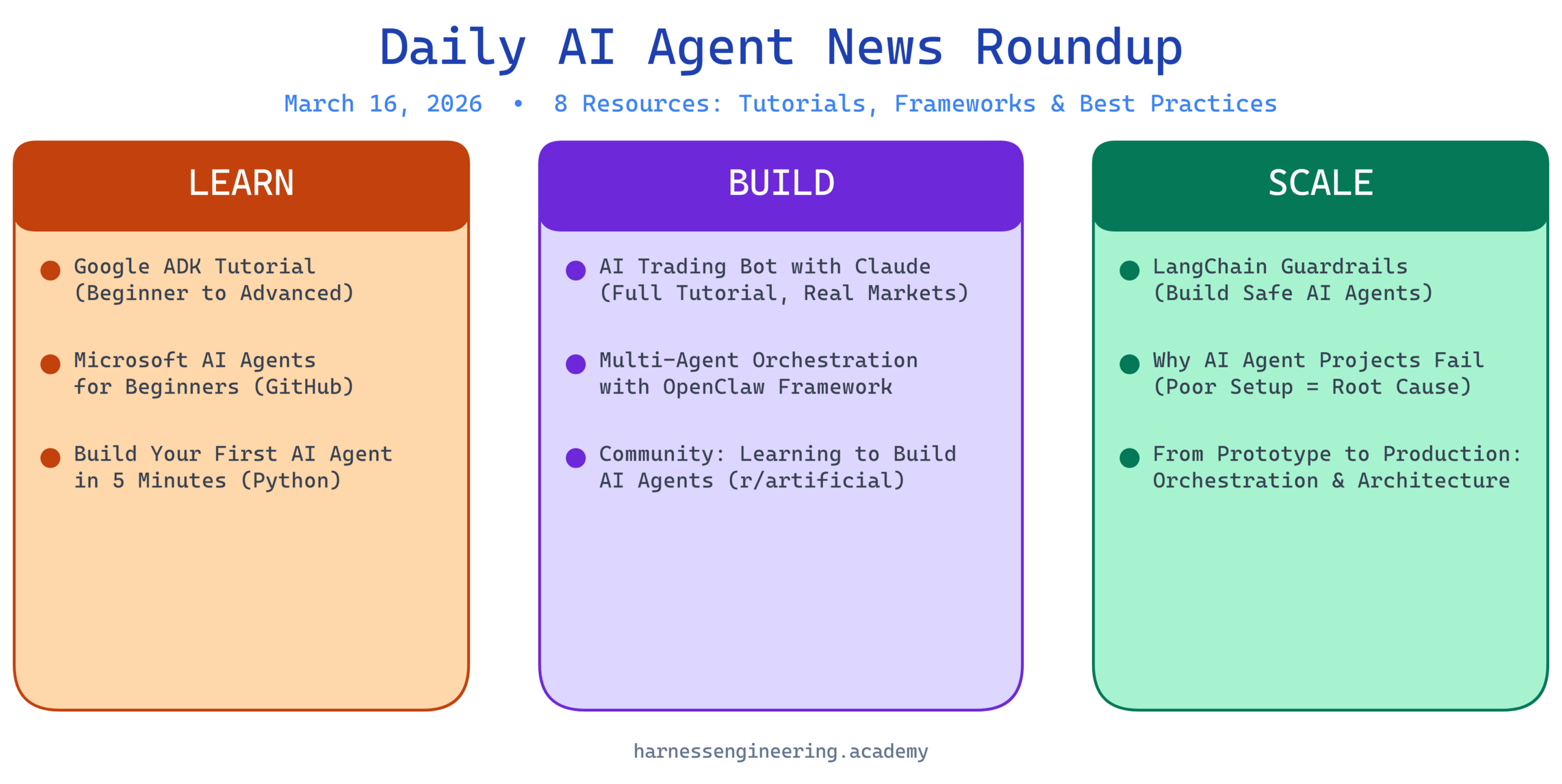
The AI agent landscape continues to evolve rapidly, with new frameworks, tutorials, and best practices emerging daily. As organizations increasingly adopt autonomous agents for everything from customer service to financial trading, developers need access to quality educational resources and practical guidance. Today’s roundup highlights the best content for both newcomers entering the field and experienced practitioners looking to refine their approach to building scalable, reliable AI agent systems.
1. Google ADK Tutorial: Build AI Agents & Workflows from Scratch (Beginner to Advanced)
Google’s release of the Agent Development Kit (ADK) represents a significant milestone for the AI agent ecosystem, providing developers with a comprehensive, production-ready framework for building autonomous agents. This detailed tutorial walks through the entire development lifecycle, from foundational concepts to advanced deployment patterns, making it an essential resource for developers at any skill level. The ADK’s emphasis on structured workflows and built-in best practices addresses one of the industry’s biggest challenges: helping developers build agents that actually work reliably in production environments.
2. Microsoft’s ai-agents-for-beginners Repository
Microsoft’s decision to create a dedicated, beginner-friendly curriculum for AI agent development signals the maturation of the field and recognizes that accessibility is key to widespread adoption. This GitHub repository offers structured lessons that progress logically from basic concepts to complex multi-agent systems, complete with code examples and explanations. The timing is particularly relevant as enterprises scramble to build internal expertise—Microsoft’s open-source approach democratizes knowledge that would otherwise require expensive consulting or trial-and-error learning.
3. Build Your First AI Agent in 5 Minutes | Agentic AI Course | Python Project
In a field where time-to-value matters tremendously, this quick-start guide delivers exactly what aspiring AI engineers need: a working prototype in minimal time. The 5-minute approach removes friction from the learning process, allowing developers to experience functional AI agent behavior before diving into more complex architectures. Quick wins like these are crucial for building momentum in careers and projects—they transform AI agents from an abstract concept into something tangible that developers can extend and build upon.
4. Deploy Your Own AI Agent Trading Bot Using Claude Full Tutorial
Financial services represent one of the most lucrative and demanding use cases for AI agents, requiring agents to make decisions under uncertainty while managing real financial risk. This comprehensive trading bot tutorial demonstrates how modern LLMs like Claude can be integrated into autonomous trading systems, complete with market data integration, decision-making logic, and deployment considerations. For developers interested in fintech, this content bridges the gap between theoretical agent design and real-world applications where performance directly impacts revenue.
5. Multi Agent Orchestration with OpenClaw
While single-agent systems are valuable, the real power of agentic AI often emerges when multiple agents coordinate to solve complex problems. This tutorial on OpenClaw tackles the critical challenge of orchestrating multi-agent systems—deciding how agents communicate, coordinate task execution, and resolve conflicts. As organizations deploy AI agents at scale, orchestration becomes a key differentiator between systems that work smoothly and those that create bottlenecks or inconsistent behavior.
6. Learning and Building AI Agents – Community Discussion
The vibrant discussion thread on Reddit’s r/artificial captures the real questions and challenges practitioners face when building AI agents in production. Community-driven conversations offer perspectives that curated tutorials sometimes miss—gotchas, failed approaches, alternative architectures, and hard-won lessons from developers in the trenches. This resource emphasizes that building scalable AI agents with LLMs and tool-calling workflows remains as much art as science, with no single “right way” to approach most problems.
7. Guardrails with LangChain 🚀 Build Safe AI Agents Like a Pro
Safety and reliability are becoming non-negotiable requirements for AI agents, especially in customer-facing applications where agent mistakes directly impact users and brand reputation. This crash course on LangChain guardrails provides practical techniques for constraining agent behavior, validating outputs, and preventing common failure modes. As organizations move agents from proof-of-concept to production, guardrails transition from “nice to have” to essential infrastructure—this content addresses a maturity gap that many teams face.
8. Why AI Agent Projects Fail: Poor Setup as the Root Cause
Perhaps the most valuable lesson in AI agent development isn’t about algorithms or frameworks—it’s about recognizing that project failures rarely stem from model limitations. This analysis of why AI agent projects derail focuses on foundational setup decisions: system prompt design, tool selection, error handling, and infrastructure choices. Understanding failure modes upfront allows teams to avoid expensive rework later, making this content particularly valuable for managers and architects designing AI agent initiatives.
What This Means for AI Agent Development Today
The breadth of resources available in today’s roundup reflects a field in transition. We’re moving from “can we build AI agents?” (clearly yes) to “how do we build AI agents that work reliably at scale?” The emphasis on tutorials, frameworks, and best practices indicates that the bottleneck has shifted from capability to adoption and execution.
For beginners, this is the best time to enter the field. The learning curve has flattened dramatically with resources like Microsoft’s curriculum and Google’s ADK. Instead of wrestling with framework basics, newcomers can quickly grasp core concepts and move to interesting application domains.
For experienced practitioners, the focus shifts to orchestration, safety, and architecture—building systems where multiple agents collaborate reliably. The emphasis on “why projects fail” suggests the community is learning hard lessons about the gap between working prototypes and production systems.
The convergence of major tech companies (Google, Microsoft) with open-source communities and independent creators points to genuine enthusiasm and investment in the AI agent space. This isn’t hype—it’s the infrastructure-building phase of a major technological shift.
Bottom line: Whether you’re just starting or scaling agents in production, today’s resources cover the full spectrum. Start with quick wins, learn from community experiences, and invest in safety and orchestration as you scale.