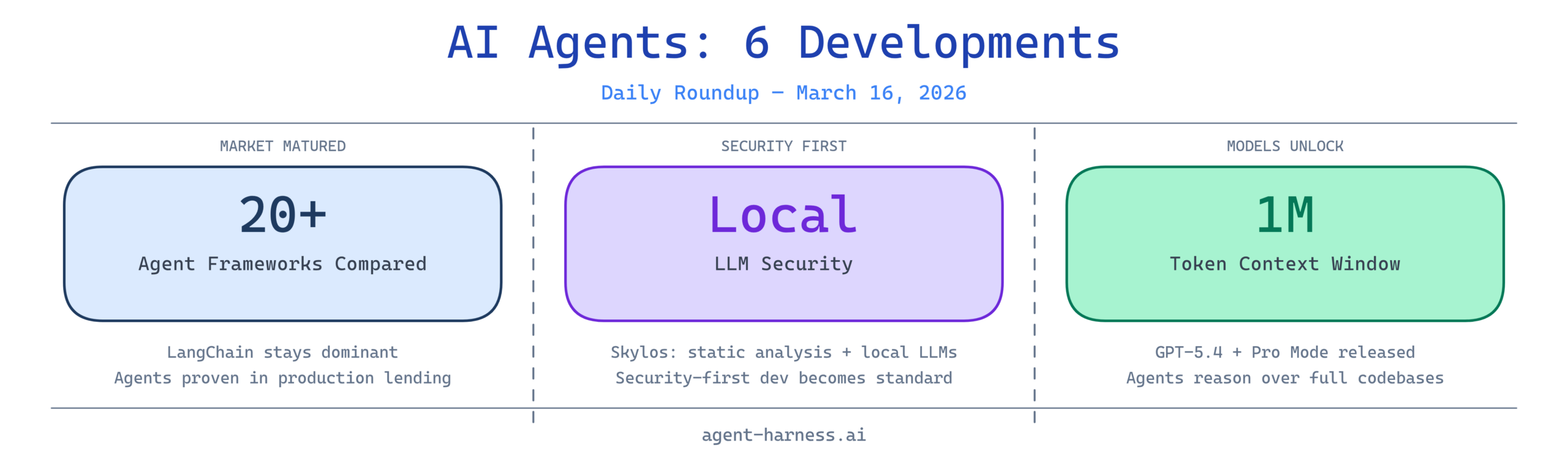
The AI agent landscape continues to accelerate at breakneck speed. Today’s roundup captures critical developments spanning framework engineering, real-world applications, security innovations, and major model releases that are reshaping what’s possible in autonomous AI systems. Whether you’re building agents, deploying them in production, or evaluating frameworks for your next project, this digest covers the stories that matter.
1. LangChain Reinforces Its Position as the Foundational Agent Framework
Source: GitHub – langchain-ai/langchain
LangChain’s continued prominence in the AI agent engineering ecosystem underscores its critical role as the de facto standard for developers building complex agent systems. The framework’s modular architecture and extensive tool integrations have made it the go-to choice for thousands of production deployments, from simple retrieval-augmented generation (RAG) systems to sophisticated multi-agent orchestrations. As newer frameworks emerge and the competitive landscape intensifies, LangChain’s sustained momentum reflects both its maturity and its ability to evolve alongside the rapidly changing demands of modern AI applications.
The framework’s importance lies not just in its current capabilities, but in how it’s shaped the broader conversation about what agent infrastructure should look like—establishing patterns for tool integration, memory management, and agentic loops that have influenced virtually every subsequent framework in the space.
2. AI Agents Prove Their Worth in Real Lending Workflows
Source: Reddit – Benchmarked AI agents on real lending workflows
A new benchmark study examining AI agents deployed in actual lending workflows reveals compelling insights into their real-world effectiveness beyond theoretical benchmarks. The case study demonstrates measurable performance improvements in document processing, creditworthiness assessment, and loan application automation—areas where precision and reliability are non-negotiable. This shift from lab environments to production financial services is a watershed moment for the industry, proving that agents aren’t just research curiosities but viable tools for regulated, high-stakes domains.
What makes this particularly significant is that lending is one of the most legally and operationally complex domains in finance, meaning successful agent deployment here validates their viability across countless other regulated industries like healthcare, insurance, and legal services.
3. Skylos Brings Security-First AI Agent Development to the Forefront
Source: GitHub – duriantaco/skylos
Skylos introduces a compelling approach to AI agent security by combining static analysis with local LLM agents, addressing growing concerns around agent safety and trustworthiness. The framework allows developers to analyze and secure agent behavior before deployment, running security-focused agents on local infrastructure rather than relying on external API calls. This represents a meaningful shift in how the industry thinks about agent reliability—moving beyond pure performance metrics to include comprehensive security postures.
As AI agents gain access to more sensitive systems and data, the ability to audit, verify, and constrain agent behavior becomes paramount. Skylos’ emphasis on static analysis paired with agentic reasoning creates a new category of developer tools that should become standard practice in production agent deployments.
4. Comprehensive Benchmark: 20+ AI Agent Frameworks Compared
Source: Reddit – Comprehensive comparison of every AI agent framework in 2026
An exhaustive comparison across the rapidly expanding landscape of AI agent frameworks—including LangChain, LangGraph, CrewAI, AutoGen, Mastra, DeerFlow, and 20+ additional options—provides much-needed clarity for developers trying to navigate framework selection. The analysis evaluates each framework across critical dimensions including API design, scalability, tool ecosystem, community support, and production-readiness. This kind of systematic comparison is invaluable as the market fragments across specialized solutions, each optimizing for different use cases and developer preferences.
The sheer number of viable frameworks reflects both the maturity of the space and the healthy competition driving innovation, though it also underscores the challenge developers face in making informed technology choices. This comprehensive guide serves as a crucial reference point for anyone architecting agent systems in 2026.
5. Understanding the Architecture of Modern Coding Agents
Source: YouTube – The Rise of the Deep Agent: What’s Inside Your Coding Agent
As AI coding tools rapidly evolve from simple code-completion utilities to sophisticated autonomous systems, understanding the distinction between basic LLM workflows and advanced, reliable AI agents has become essential. The video explores what separates genuine agents—systems with planning, tool use, and adaptive reasoning—from simpler automation scripts. For developers and engineering leaders evaluating which tools to adopt, this distinction matters enormously: a basic LLM can suggest code snippets, but a deep agent can architect entire features, debug complex systems, and make reasoned decisions about trade-offs.
The “deep agent” concept articulates an important inflection point in AI-assisted development where the tool transitions from augmentation to autonomous capability, raising both exciting possibilities and important questions about code quality, security, and the role of human review.
6. OpenAI Releases GPT-5.4 with Game-Changing 1 Million Token Context
Source: YouTube – OpenAI Drops GPT-5.4 – 1 Million Tokens + Pro Mode | YouTube – 5 Crazy AI Updates This Week | YouTube – 5 Crazy AI Updates This Week!
OpenAI’s release of GPT-5.4 represents a watershed moment for AI agents, introducing a 1 million token context window that fundamentally expands what’s possible in agentic systems. This capability allows agents to ingest entire codebases, comprehensive documentation, extended conversation histories, and complex task specifications in a single request—eliminating the context fragmentation that has plagued agent design. The accompanying Pro Mode brings premium performance tiers that offer faster inference and priority access, addressing the operational considerations of production agent deployments.
The implications for agent engineering are profound: agents can now maintain richer situational awareness, work with more sophisticated reasoning chains, and operate more effectively on complex, multi-step problems that previously required careful context management. For frameworks like LangChain and newcomers alike, this capability shift will likely drive rapid iterations in how agents are architected to leverage vastly expanded context windows.
Key Takeaways
Three themes emerge clearly from today’s developments:
1. The Agent Market Has Matured Beyond Hype
Real-world deployments in regulated industries like lending, combined with systematic framework comparisons and security-focused tools, demonstrate that agents have transitioned from research concepts to production infrastructure. The conversation has shifted from “can agents work?” to “which framework is right for my use case?”
2. Security and Reliability Are Moving Upstream
Tools like Skylos reflect the industry’s growing recognition that trustworthy agents require deliberate architectural choices around observability, constraint, and verification. This will likely become table-stakes for enterprise deployments.
3. Model Capabilities Directly Unlock Agent Potential
OpenAI’s 1 million token context window is a perfect example of how underlying model improvements directly translate into architectural possibilities for agents. As models get better at reasoning, planning, and understanding context, agents become more capable and reliable.
What’s next: Watch for framework updates that fully leverage the new context window capabilities, enterprise deployments in regulated industries, and a likely wave of agent-focused security and observability tools. The next phase of this market will be less about building agents and more about building trustworthy, observable, production-ready agents.
Subscribe to stay updated on the latest in AI agent development, frameworks, and real-world applications.