The AI agent landscape continues to evolve at a rapid pace, with organizations moving beyond experimentation into production deployment at scale. Today’s news cycle highlights the critical intersection of practical engineering challenges, security vulnerabilities, and the dramatic shift in how enterprises are integrating AI agents into their core operations. From lessons learned in the trenches to Microsoft’s latest enterprise push, the focus is increasingly on how to build, secure, and manage AI agents effectively in real-world environments. Here are today’s essential stories for anyone working with or deploying AI agents.
1. Lessons From Building and Deploying AI Agents to Production
Real-world deployment of AI agents reveals a significant gap between theoretical capabilities and production-ready systems. This exploration of lessons learned highlights the critical engineering decisions that separate successful deployments from costly failures, covering topics like error handling, monitoring, and graceful degradation when agents encounter unexpected scenarios.
The transition from development to production requires fundamentally different thinking about reliability, observability, and human oversight. Practitioners emphasize the importance of building robust fallback mechanisms, implementing comprehensive logging and monitoring, and maintaining human-in-the-loop checkpoints for critical decisions. Understanding these lessons early can save organizations months of troubleshooting and millions in lost productivity.
2. Test Your AI Agents Like a Hacker – Automated Prompt Injection Attacks
As AI agents gain autonomy and access to critical systems, prompt injection attacks represent one of the most pressing security challenges facing the industry. This deep dive into automated testing methodologies shows how adversarial techniques can be used defensively to expose vulnerabilities before malicious actors do, including sophisticated attacks that manipulate agent behavior through carefully crafted inputs.
Security-first thinking must be embedded into the agent development lifecycle, not bolted on afterward. Teams need to understand how their agents can be manipulated through prompt injection, second-order attacks, and context confusion. Implementing systematic security testing—treating agents as potential attack surfaces—is becoming as critical as unit tests in traditional software development.
3. AI Agents Just Went From Chatbots to Coworkers
The semantic shift from “chatbots” to “coworkers” signals a fundamental change in how organizations view and deploy AI agents. Recent announcements from major tech companies indicate agents are now expected to handle complex, multi-step workflows, collaborate with human teams, and take on genuine responsibility for business outcomes—moving far beyond simple Q&A interactions.
This transition carries significant implications for harness engineering. When agents were chatbots, their scope was limited and failures were often tolerable. When they become coworkers, the expectations for reliability, context understanding, and judgment become substantially higher. Organizations must rethink their verification strategies, error budgets, and supervision mechanisms accordingly.
4. How I Eliminated Context-Switch Fatigue When Working with Multiple AI Agents in Parallel
Managing multiple concurrent AI agents presents a unique class of challenges that traditional software engineering frameworks weren’t designed to address. The solution lies in sophisticated context management, clear agent roles, and intelligent orchestration—ensuring that parallel agent operations remain coherent and don’t conflict with each other’s goals or output.
This discussion highlights why harness engineering is becoming essential infrastructure. Without proper mechanisms for maintaining context integrity, coordinating between agents, and preventing interference patterns, parallel agent deployments quickly become chaotic. Tools and methodologies that reduce cognitive load on teams managing multiple agents are becoming competitive advantages.
5. Microsoft Just Launched an AI That Does Your Office Work for You — and It’s Built on Anthropic’s Claude
Microsoft’s launch of Copilot Cowork represents a watershed moment for enterprise AI agent adoption, demonstrating that major technology companies are now confident enough to embed AI agents directly into core productivity workflows. The integration with Anthropic’s Claude as the foundation model signals the importance of using capable, reliable model infrastructure when building agents intended for real business operations.
This launch validates the thesis that AI agents can create measurable business value through automation of knowledge work. However, it also illustrates why harness engineering matters: the success of such systems depends entirely on their ability to maintain accuracy, provide clear reasoning for decisions, and fail gracefully when uncertain. Users working alongside AI agents need confidence in their outputs.
6. Building AI Coding Agents for the Terminal: Scaffolding, Harness, Context Engineering
The specialized domain of terminal-based coding agents reveals how harness engineering principles apply to highly technical workflows. Coding agents must understand complex project structures, maintain awareness of development context, integrate with existing tools, and make decisions that materially impact development velocity—requiring sophisticated scaffolding and context engineering to operate effectively.
Terminal environments are among the most unforgiving contexts for AI agents because mistakes are immediately visible and can have cascading consequences. This content explores how to structure agents for these environments, from how to provide relevant context about the codebase to how to verify that suggested changes are actually correct. The techniques here are broadly applicable to any domain-specific agent deployment.
7. Harness Engineering: Supervising AI Through Precision and Verification
Supervision of AI systems is undergoing a fundamental reconceptualization as agents become more capable and autonomous. Rather than detailed human review of every output, modern harness engineering emphasizes precision (ensuring agents only operate within their competence envelope) and verification (systematically checking that outputs meet quality standards before they affect the world).
This methodology shift reflects a practical reality: organizations cannot hire enough human reviewers to supervise every AI agent decision in real time. Instead, effective supervision means building agents with clear boundaries, explicit confidence assessment, and automated verification pipelines. The goal is to create systems that can operate at scale while maintaining human confidence and organizational control.
8. AI Agents: Skill & Harness Engineering Secrets REVEALED!
The distinction between skill engineering (what agents can do) and harness engineering (how they do it reliably) is increasingly critical as the field matures. Skill engineering focuses on expanding agent capabilities—new tools, better reasoning, broader domain knowledge. Harness engineering ensures those skills are applied correctly, safely, and predictably, with appropriate human oversight and error recovery.
Understanding this duality is essential for teams building production AI agents. You can have highly capable agents that are unreliable in production, or constrained agents that always behave predictably. The art lies in balancing capability with controllability—developing skills while simultaneously building harnesses that ensure those skills are exercised appropriately.
Key Takeaways
Today’s news cycle reinforces several critical themes for anyone working with AI agents:
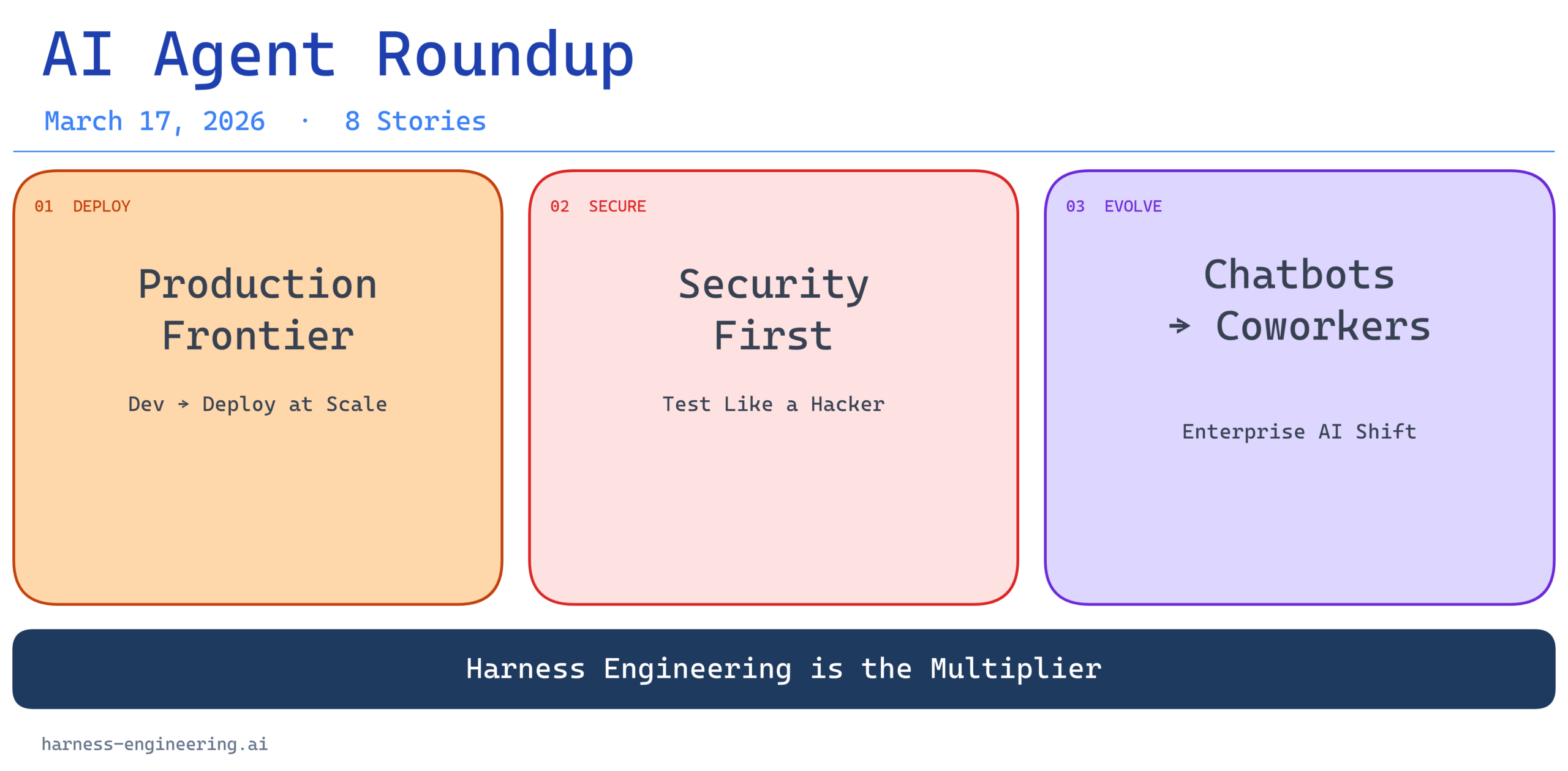
Production deployment is the frontier. The easy problems—can AI agents work at all?—have been solved. The hard problems are deployment, reliability, security, and scale. Organizations are investing heavily because agents can create real business value, but that value only materializes when systems are production-ready.
Security must be built in early. Prompt injection and related vulnerabilities aren’t theoretical risks; they’re active threats that need to be understood and tested for during development. Security-first thinking is becoming table stakes.
Harness engineering is the multiplier. Raw AI capability means little without the engineering scaffolding that ensures reliable, supervised, controllable operation. The most successful agent deployments will be those with the strongest harness engineering foundations.
Context and coordination matter immensely. Whether managing multiple agents in parallel or ensuring a single agent understands its operational environment, context engineering is where many deployments stumble. Getting this right is critical to scaling agent usage.
As AI agents transition from research projects to workplace infrastructure, the emphasis rightfully shifts from “what can agents do” to “how do we build, secure, and operate agents at scale.” The leaders in this field will be those who master not just agent development, but the full harness engineering discipline that makes agents trustworthy, controllable, and genuinely valuable.