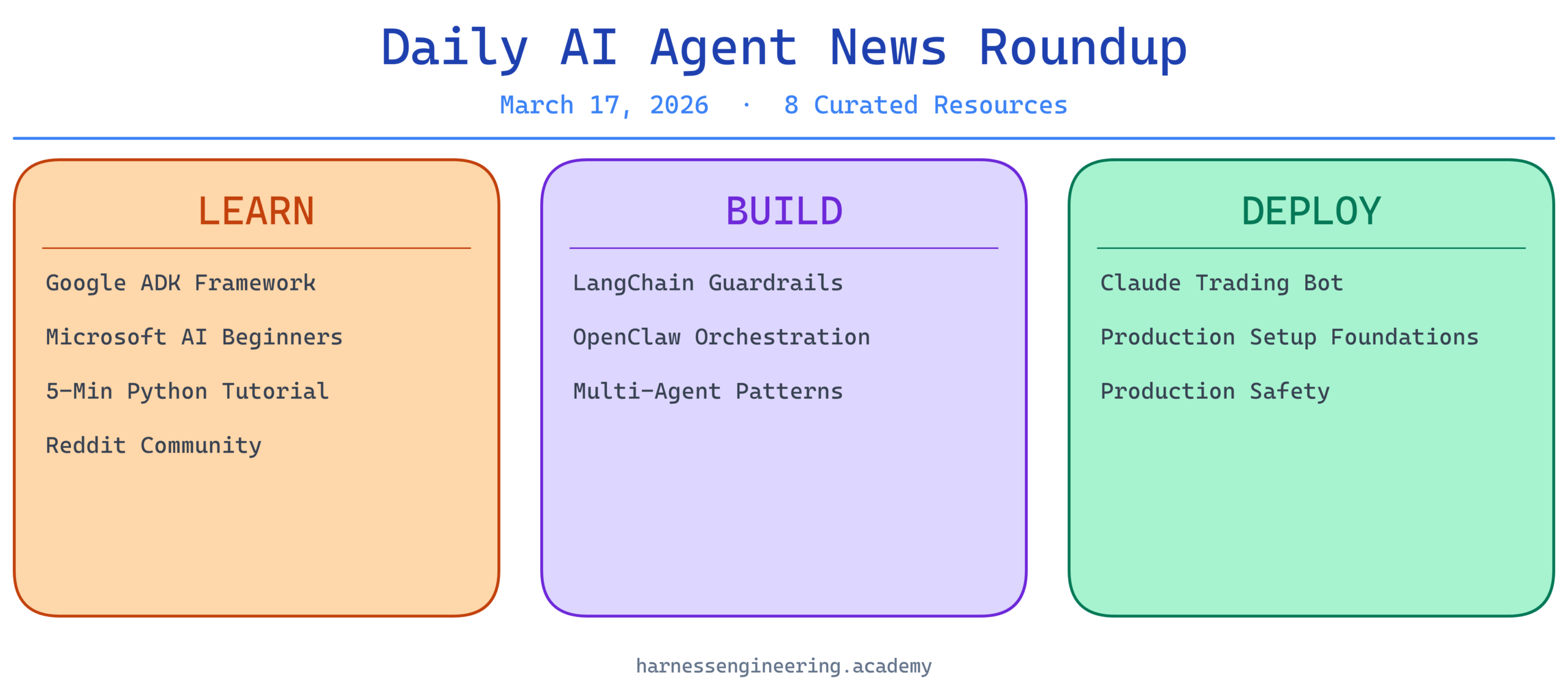
The AI agent landscape continues to accelerate as frameworks mature, educational resources proliferate, and developer adoption reaches inflection point. Today’s roundup captures the latest tutorials, frameworks, and community discussions shaping how developers build, deploy, and orchestrate intelligent autonomous systems. From Google’s comprehensive ADK framework to practical trading bot deployments, this collection reflects the growing accessibility of agentic AI.
1. Google ADK Tutorial: Build AI Agents & Workflows from Scratch (Beginner to Advanced)
Google’s Agent Development Kit (ADK) has emerged as a comprehensive framework for building AI agents at any skill level. This tutorial walks developers through the entire spectrum from foundational concepts to advanced implementations, covering everything from basic agent architecture to complex multi-step workflows. The ADK’s structured approach to agent development makes it a critical resource for teams looking to operationalize AI agents in production environments.
Analysis: Google’s entry into the agent development tooling space signals a major shift in the AI infrastructure landscape. By providing a complete framework from concept to deployment, Google is lowering the barriers to entry while establishing standards that could influence enterprise adoption patterns. The beginner-to-advanced progression suggests the framework is designed for organizations at various stages of their AI maturity, making it valuable both for individual developers and teams scaling agent-based solutions.
2. microsoft/ai-agents-for-beginners
Microsoft’s open-source AI agents for beginners repository delivers a structured curriculum designed specifically for developers entering the agentic AI field. The repository provides hands-on lessons, code examples, and progressive learning paths that make AI agent concepts accessible to those without deep machine learning backgrounds. This educational resource aligns with Microsoft’s broader commitment to democratizing AI development across its ecosystem.
Analysis: Microsoft’s beginner-focused curriculum addresses a critical gap in AI education—practical, hands-on resources that don’t require PhD-level mathematics or deep ML expertise. The open-source approach amplifies its reach and potential impact, creating a shared knowledge base that can accelerate industry-wide competency. This positions Microsoft favorably among developers evaluating platforms for their first AI agent projects, particularly in enterprise contexts where structured learning paths are valued.
3. Build Your First AI Agent in 5 Minutes | Agentic AI Course | Python project
This rapid-start guide demonstrates how to build a functional AI agent in just five minutes using Python. The ultra-compressed timeline makes AI agent development feel achievable for complete beginners, removing psychological friction that often prevents exploration. By focusing on the “happy path” of agent creation, this tutorial makes the technology feel less intimidating and more immediately actionable.
Analysis: The “5-minute agent” narrative serves an important function in the developer ecosystem—it establishes a psychological foothold that reduces the perceived effort required to begin experimenting with AI agents. While a production agent requires significantly more work, this quick-start approach serves as an effective gateway drug that converts curiosity into hands-on engagement. The video’s popularity reflects genuine demand for quick-start content that lets developers validate whether agentic AI is worth deeper investment.
4. Deploy Your Own AI Agent Trading Bot Using Claude Full Tutorial
This comprehensive tutorial walks through the complete lifecycle of deploying an autonomous trading bot powered by Claude. The guide covers agent architecture, financial market integration, risk management considerations, and live deployment strategies. By using a concrete, high-stakes use case like trading, the tutorial illustrates how AI agents can be applied to real business problems with significant economic implications.
Analysis: Trading bot tutorials occupy an interesting position in the AI agent landscape—they attract significant developer interest due to the potential financial upside, while also showcasing sophisticated agent capabilities like multi-step reasoning, external tool integration, and continuous operation. The focus on Claude specifically reflects Anthropic’s growing share of the agentic AI developer mindshare. For enterprise audiences, this type of content demonstrates that AI agents can handle complex, multi-stakeholder scenarios where reliability and accuracy are non-negotiable.
5. Multi Agent Orchestration with OpenClaw
As individual AI agents mature, the challenge of coordinating multiple agents to work together becomes increasingly pressing. This tutorial on OpenClaw explores orchestration patterns, coordination mechanisms, and the architectural decisions required when scaling from single-agent to multi-agent systems. Understanding how to compose agents into larger systems is becoming essential knowledge for teams building production applications.
Analysis: Multi-agent orchestration represents the next frontier in agentic AI complexity. While single-agent systems are increasingly commoditized, the ability to compose multiple specialized agents into coherent workflows remains a competitive advantage. OpenClaw’s emergence as a dedicated orchestration tool reflects market recognition that this problem requires first-class solutions. Developers investing in orchestration patterns today are positioning themselves ahead of the curve as this capability becomes table-stakes for enterprise deployments.
6. Learning and Building AI Agents Reddit Discussion
Community discussion on Reddit reveals the practical concerns and learning paths developers are pursuing as they enter the AI agents space. The thread captures common questions about where to start, what tools to use, and how to move from theoretical understanding to shipped projects. These organic community conversations provide unfiltered insight into the barriers and friction points developers actually experience.
Analysis: Reddit discussions serve as a leading indicator of genuine developer pain points and knowledge gaps. The active participation in agent-related threads reflects sustained, authentic interest rather than hype-driven attention. For educators and tool developers, these conversations highlight which conceptual areas remain unclear and which real-world problems are most urgent. The community-sourced nature of solutions in these threads also creates organic knowledge transfer that’s often more practical than formal documentation.
7. Guardrails with LangChain: Build Safe AI Agents Like a Pro
Safety and guardrails are moving from afterthoughts to first-class concerns in AI agent development. This LangChain-focused crash course covers constraint-based design, output validation, action filtering, and other safety mechanisms that keep agents aligned with intended behavior. As enterprises deploy agents with access to critical systems, guardrail implementation becomes a core competency.
Analysis: The emphasis on safety reflects maturation in the AI development community. Early-stage projects often prioritized capability over safety, but production deployments demand robust guardrails that prevent agents from taking unintended actions. LangChain’s positioning as a framework that bakes in safety considerations gives it a competitive advantage for enterprise adoption. This tutorial’s existence and prominence signals that safety-conscious development is now table-stakes, not a nice-to-have.
8. Why Most AI Agent Projects Fail: Poor Setup Foundations
This retrospective analysis explores why many ambitious AI agent projects fail despite sound underlying technology. Rather than blaming model limitations, the focus lands on poor architectural setup, inadequate integration planning, and misaligned expectations about agent capabilities. Understanding these failure patterns before starting a project can prevent costly mistakes and wasted effort.
Analysis: This “learn from failures” approach provides valuable de-risking information for teams planning agent implementations. The insight that failures stem from setup and integration rather than model quality reflects market maturity—the technology is reliable enough that success is determined by execution, not breakthrough innovation. Teams that internalize these lessons can avoid reinventing problems already solved, compressing time-to-value and reducing project risk.
Key Takeaway
March 17, 2026 marks a clear inflection point where AI agent development is transitioning from specialized research to accessible engineering practice. The convergence of mature frameworks (Google ADK, LangChain), structured educational resources (Microsoft, YouTube tutorials), and practical deployment examples (trading bots, orchestration) indicates the field has matured beyond “can we build this?” to “what should we build and how do we build it responsibly?”
The proliferation of beginner-focused content alongside advanced topics like multi-agent orchestration and safety guardrails suggests the market is growing vertically—simultaneously onboarding newcomers while helping experienced developers tackle sophisticated problems. Teams evaluating whether to invest in AI agents should view today’s resource abundance as a signal that the tooling, education, and community infrastructure are finally mature enough to support production adoption.
For developers and engineering leaders, the message is clear: the barrier to entry is lower than ever, but success depends less on accessing the right tools and more on avoiding common implementation pitfalls. Start with the quick-start tutorials to validate the fit, move to comprehensive frameworks for production work, and invest early in safety and orchestration patterns that will define next-generation AI systems.
Daily roundups bring you curated AI agent news, frameworks, and community insights from around the web. Covering the resources and discussions shaping agentic AI development.