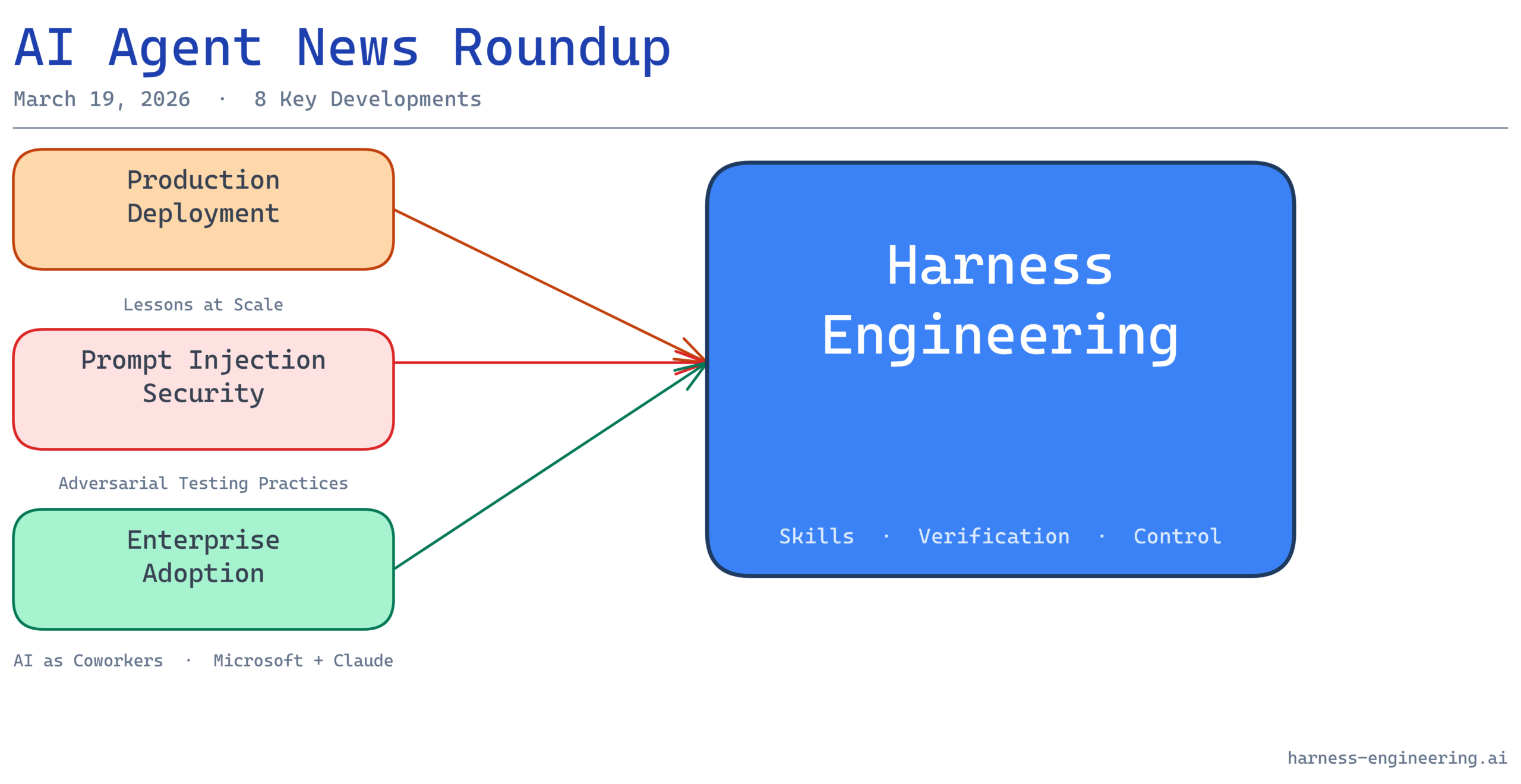
The AI agent landscape is evolving at a rapid pace, with significant developments in production deployment strategies, security practices, and enterprise integration. This week’s roundup highlights critical lessons from practitioners, emerging security concerns, and the accelerating shift of AI agents from experimental tools to essential workplace technologies. For teams building and deploying AI agents, understanding these trends is essential for staying competitive and maintaining system reliability.
1. Lessons From Building and Deploying AI Agents to Production
Drawing from real-world experiences, this resource outlines key lessons and best practices for successfully deploying AI agents in production environments. The content covers the practical challenges that teams face when moving from prototypes to live systems, including architectural decisions, failure modes, and monitoring strategies.
Analysis: As organizations scale beyond proof-of-concept phases, production deployment has become the critical bottleneck. This discussion underscores that success requires more than algorithmic improvements—it demands careful attention to system design, infrastructure, and operational practices. Teams should prioritize understanding these real-world lessons early in their deployment planning to avoid costly mistakes at scale.
2. Test Your AI Agents Like a Hacker – Automated Prompt Injection Attacks
This session explores systematic approaches to testing AI agent vulnerabilities, specifically focusing on automated prompt injection attacks that can compromise agent behavior and security. The content demonstrates how adversaries can manipulate agent inputs to bypass intended constraints and execute unintended actions.
Analysis: Prompt injection attacks represent one of the most underestimated security risks in deployed AI systems. As agents gain access to sensitive data and critical workflows, security testing must become as rigorous as traditional penetration testing. Organizations deploying agents should adopt adversarial testing practices now rather than discovering vulnerabilities in production environments where the stakes are highest.
3. AI Agents Just Went From Chatbots to Coworkers
Recent announcements from major tech companies highlight a fundamental shift: AI agents are transitioning from simple conversational interfaces to active participants in complex business workflows. This represents a significant expansion in agent capabilities, autonomy, and organizational impact.
Analysis: This transition signals a maturation of the AI agent space and reflects growing confidence in deploying agents for consequential work. However, it also raises new challenges around governance, accountability, and integration with existing teams. Organizations need to think beyond the agent itself to consider how these systems fit into broader organizational structures and workflows.
4. How I eliminated context-switch fatigue when working with multiple AI agents in parallel
This community discussion addresses a practical pain point: managing multiple AI agents operating simultaneously without losing track of state, goals, or coordination. The solutions presented focus on systematic approaches to state management, communication protocols, and cognitive load reduction.
Analysis: As teams deploy multiple specialized agents, the problem shifts from “can agents do useful work?” to “can humans effectively supervise and coordinate multiple agents?” The techniques discussed here—likely involving structured communication, explicit state tracking, and thoughtful UI design—become essential for scaling agent deployments from single-agent use cases to multi-agent systems.
5. Microsoft just launched an AI that does your office work for you — and it’s built on Anthropic’s Claude
Microsoft’s launch of Copilot Cowork represents a major milestone in bringing AI agents into everyday office environments. Built on Anthropic’s Claude, this agent demonstrates the viability of deploying capable AI systems for real-world knowledge work across organizations of all sizes.
Analysis: This launch validates the business case for AI agents in enterprise workflows and shows how strong foundational models (like Claude) provide the reliability needed for office work applications. The focus on “work you actually do” rather than aspirational capabilities suggests the market is moving toward practical, immediately valuable agents. This is a watershed moment for agent adoption in non-technical organizations.
6. Building AI Coding Agents for the Terminal: Scaffolding, Harness, Context Engineering
This technical deep-dive explores how to build AI agents specifically designed for terminal environments, emphasizing scaffolding structures, harness engineering principles, and sophisticated context management. The approach focuses on giving agents the right abstractions and information to reason about code and system interactions.
Analysis: Specialized agents for code generation and system manipulation require different design patterns than general-purpose conversational agents. The emphasis on scaffolding and harness engineering highlights that successful agents aren’t just about raw model capability—they’re about carefully structuring the agent’s environment and decision-making framework. This is particularly critical for coding agents where errors can have serious consequences.
7. Harness Engineering: Supervising AI Through Precision and Verification
With increasing complexity in AI systems, harness engineering has emerged as a critical discipline for ensuring reliable AI outputs. This session explores methodologies for supervising AI agents through precise specification, verification mechanisms, and monitoring strategies.
Analysis: “Harness engineering” is the emerging discipline of building the frameworks and constraints that allow AI agents to operate reliably and safely. Rather than hoping models behave correctly, harness engineering involves explicit verification, constraint satisfaction, and continuous monitoring. As agents handle more consequential work, this discipline becomes non-negotiable for responsible deployment.
8. AI Agents: Skill & Harness Engineering Secrets REVEALED!
This short-form content explores the interplay between skill engineering (developing agent capabilities) and harness engineering (building the systems to control and verify those capabilities). The combination of both disciplines is presented as essential for unlocking the full potential of AI agents.
Analysis: The framework of “skills” and “harnesses” provides a useful mental model for AI agent development. Skills represent what the agent can do; harnesses represent how we ensure it does things correctly and safely. Neither alone is sufficient—powerful skills without proper harnesses create risk, while restrictive harnesses without sufficient skills limit value.
Key Takeaways for Today
The AI agent landscape is at an inflection point. We’re seeing the convergence of three critical developments:
Technical Maturity: Production deployment is no longer experimental. Real organizations are running agents on real work, learning from the experience, and iterating rapidly.
Security Awareness: As agents become more prevalent, the security community is catching up with systematic vulnerability research. Prompt injection attacks and adversarial testing are now part of responsible deployment practices.
Enterprise Adoption: The shift from research projects to mainstream office tools (like Microsoft Copilot Cowork) indicates that AI agents are becoming standard infrastructure rather than differentiators.
For teams building agents, this means the competitive advantages lie not just in model capability but in the “harness”—the careful engineering of controls, verification systems, and operational practices that allow powerful models to operate reliably at scale. Organizations that master both skill development and harness engineering will be best positioned to capture value from this technology wave.
Next roundup: March 20, 2026