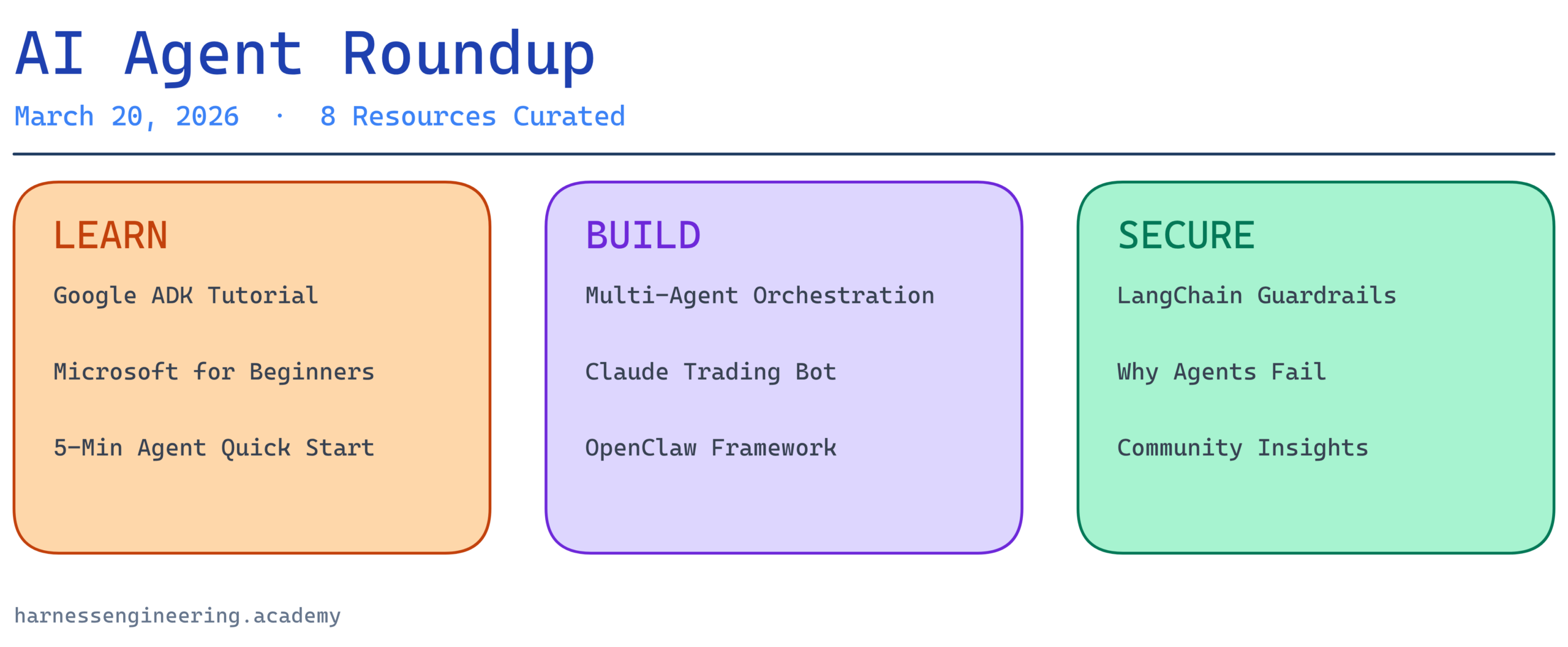
The AI agent ecosystem continues to accelerate with an unprecedented influx of educational resources, frameworks, and practical guides. Today’s roundup reflects a pivotal moment in agentic AI development—from foundational learning paths to advanced deployment strategies, the barrier to entry for building intelligent autonomous systems has never been lower. Whether you’re a beginner looking to launch your first agent or a seasoned developer optimizing multi-agent orchestration, today’s news highlights the tools and knowledge you need to stay ahead of the curve.
1. Google ADK Tutorial: Build AI Agents & Workflows from Scratch (Beginner to Advanced)
Google’s Agent Development Kit (ADK) represents a significant step toward democratizing AI agent development. This comprehensive tutorial guides developers through the entire spectrum of agent building—from foundational concepts to advanced workflows—using Google’s native framework. The structured approach makes complex concepts accessible while maintaining depth for experienced practitioners.
Analysis: Google’s entry into the agent-building education space signals growing confidence in agentic AI as a core development skill. By providing a complete beginner-to-advanced curriculum, Google is positioning developers to rely on its ecosystem for production-grade agent applications. This tutorial is essential for teams evaluating Google’s tooling against competing frameworks from OpenAI, Anthropic, and Microsoft.
2. microsoft/ai-agents-for-beginners
Microsoft’s open-source learning repository offers a structured, beginner-friendly introduction to AI agent fundamentals. The project combines educational content with hands-on examples, making it an ideal starting point for developers new to agentic AI. With Microsoft’s backing, the repository benefits from enterprise-grade quality and regular updates.
Analysis: The timing of Microsoft’s educational push aligns with the broader industry shift toward agentic computing. By releasing free, accessible learning materials on GitHub, Microsoft is building developer mindshare early—creating a pipeline of developers familiar with its agent frameworks. This is classic platform strategy: educate first, convert to enterprise tools later.
3. Build Your First AI Agent in 5 Minutes | Agentic AI Course | Python project
Speed-to-value has become the defining characteristic of modern developer tools. This 5-minute quick-start guide lowers the activation energy for experimenting with agentic AI, allowing developers to build a functional agent before their coffee gets cold. The Python-native approach ensures accessibility for the vast majority of AI practitioners.
Analysis: The explosive demand for “quick-start” AI agent content reveals something crucial: developers want to build, not just learn. This reflects a maturation of the AI agent space—we’re past the hype phase and into practical implementation. However, the gap between a 5-minute proof-of-concept and production-ready code remains significant. Developers should view these quick starts as explorations, not blueprints.
4. Deploy Your Own AI Agent Trading Bot Using Claude Full Tutorial
The intersection of autonomous AI and financial markets continues to attract developer attention. This tutorial demonstrates deploying a trading bot powered by Claude, showcasing how language models can be applied to real-world, high-stakes decision-making. The comprehensive approach covers architecture, risk management, and integration with financial APIs.
Analysis: Trading bots represent one of the highest-stakes applications for AI agents—a single logic error can result in significant financial loss. The availability of detailed tutorials signals growing confidence in LLM reliability for financial applications, though developers should approach with appropriate risk management and compliance considerations. This vertical demonstrates the economic incentive driving AI agent adoption.
5. Multi Agent Orchestration with OpenClaw
As single-agent applications reach their limits, multi-agent orchestration has become a critical skill. OpenClaw provides a framework for coordinating multiple specialized agents toward complex goals. This tutorial addresses the architectural challenges of orchestration—agent communication, task decomposition, and result aggregation.
Analysis: Multi-agent systems represent the next frontier in agentic AI. While single agents excel at narrow tasks, real-world problems often benefit from teams of specialists. However, orchestration complexity increases exponentially with team size. This content is essential for developers planning to build sophisticated autonomous systems capable of handling high-complexity workflows.
6. Learning and Building AI Agents – Reddit Discussion
The Reddit community continues to serve as a practical knowledge commons for AI development. This discussion captures real practitioners sharing their learning journeys, common pitfalls, and battle-tested approaches. The peer-driven nature of the conversation provides unfiltered insights that polished tutorials often gloss over.
Analysis: Community discussions provide invaluable context missing from official tutorials. Real developers discussing their failures and successes offer a more complete picture of what it takes to ship AI agents in production. The roadmap emerging from this discussion—emphasizing LLMs and tool-calling workflows—aligns with industry consensus on the most robust agent architecture patterns.
7. Guardrails with LangChain 🚀 Build Safe AI Agents Like a Pro
Safety and reliability in AI agents demand deliberate architecture, not accident. This LangChain-focused tutorial emphasizes guardrails—the mechanisms preventing agents from taking unintended actions. Topics covered include input validation, output filtering, action whitelisting, and monitoring. The practical focus makes safety implementable for teams without dedicated security expertise.
Analysis: As AI agents graduate from prototypes to production systems, safety moves from nice-to-have to non-negotiable. The availability of frameworks and tutorials specifically addressing agent guardrails reflects this maturation. Organizations deploying agents should view this content as mandatory, not optional. LangChain’s dominance in safety-focused agent tutorials positions it as the de facto framework for responsible AI development.
8. Why AI Agent Projects Fail: It’s Not the Model
The most insightful analysis often comes from studying failure. This tutorial dissects why AI agent projects fail, with a crucial insight: the failure point is rarely the language model itself. Instead, projects stumble on setup—architecture decisions, data pipelines, tool integration, and operational considerations.
Analysis: This content validates an important principle: AI agents are software systems first, AI applications second. Teams that approach agent development with rigor around architecture, testing, and operations succeed. Those treating agents as black-box magic tend to fail. The emphasis on setup and engineering fundamentals should reassure enterprises that agent development benefits from proven software engineering practices rather than requiring entirely new disciplines.
Key Takeaways for Today
The convergence of these eight resources tells a compelling story about the current state of agentic AI:
1. Democratization is Real: From Google to Microsoft to indie creators, educational resources are proliferating. The barrier to building your first agent is now measured in minutes, not months.
2. Focus Shifts to Execution: Beyond “how to build,” the conversation is evolving to “how to build safely, reliably, and at scale.” Safety guardrails, orchestration patterns, and failure analysis are becoming central concerns.
3. Multi-Agent Systems Are Here: Single-agent applications are increasingly seen as stepping stones. The real leverage lies in orchestrating specialized agents toward complex objectives.
4. Community > Documentation: While official tutorials matter, peer discussions and battle-tested community knowledge often provide more actionable guidance. Keep one eye on Reddit, Discord, and GitHub discussions.
5. Engineering Discipline Matters: The consistent message across failure analyses and safety resources: AI agents are software systems. Traditional software engineering practices—architecture, testing, monitoring—remain essential.
For practitioners on the Harness Engineering Academy journey, today’s landscape offers unprecedented opportunity. The tools are mature, the frameworks are stable, and the knowledge is accessible. The competitive advantage now belongs to teams that can translate these resources into well-engineered, reliable systems deployed responsibly.
Stay tuned for tomorrow’s roundup as the agentic AI ecosystem continues its rapid evolution.
Subscribe to Harness Engineering Academy for daily updates on AI agents, frameworks, and best practices. Keep your skills sharp as autonomous systems reshape software development.