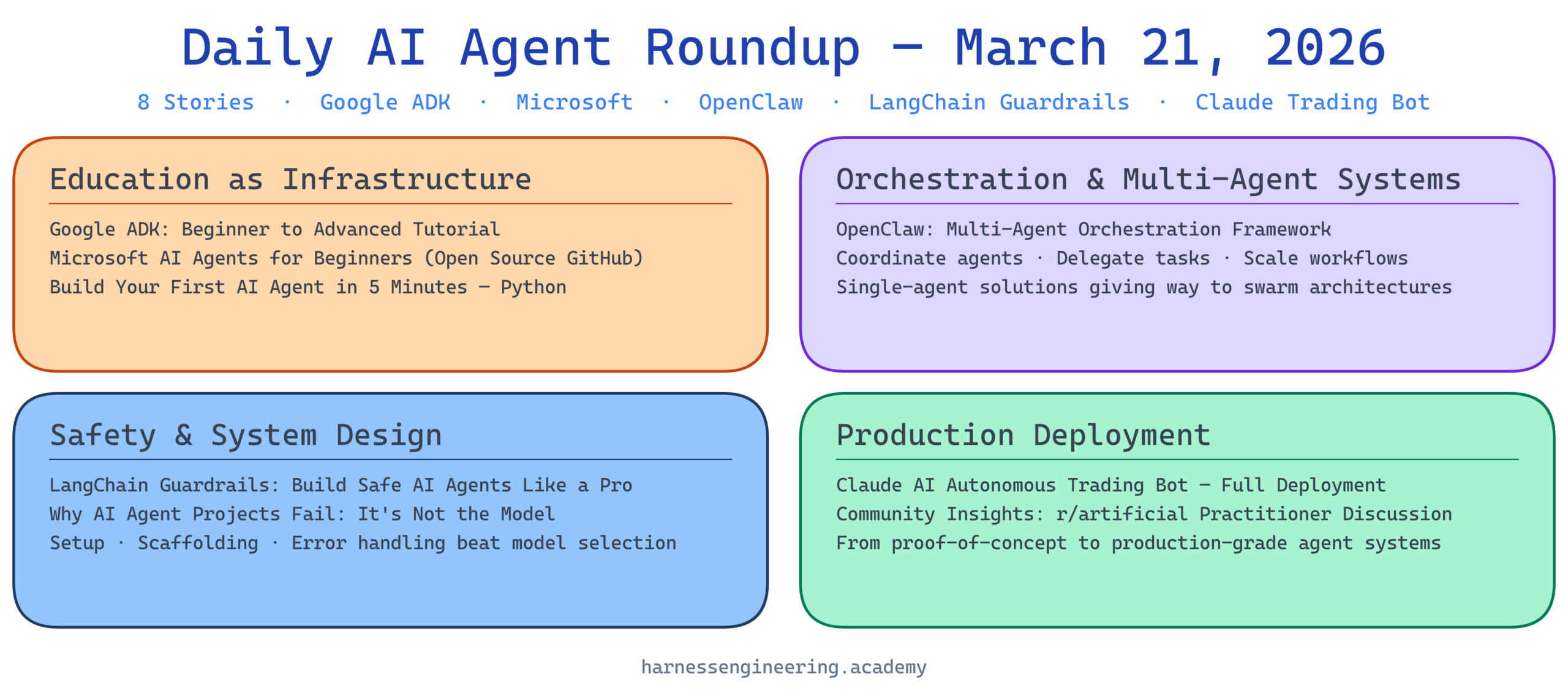
The AI agent ecosystem is exploding with new tools, tutorials, and frameworks designed to democratize agent development. As we head deeper into 2026, the focus has shifted from theoretical discussions about agentic AI to practical, hands-on resources that help developers at all skill levels build production-ready autonomous systems. Today’s roundup captures eight critical developments shaping how engineers approach agent architecture, safety, and deployment.
1. Google ADK Tutorial: Build AI Agents & Workflows from Scratch (Beginner to Advanced)
Google’s Agent Development Kit (ADK) has emerged as one of the most comprehensive frameworks for building AI agents, and their new tutorial series provides a pathway from foundational concepts to advanced implementations. The tutorial covers agent architecture, workflow design, and integration patterns—offering developers a structured approach to building agents that can handle complex multi-step tasks. With Google’s backing and integration with their broader AI infrastructure, this resource addresses a critical gap in standardized agent development practices.
Why it matters: As organizations standardize on agent frameworks, having Google’s official guidance provides both credibility and a clear path for teams choosing their tooling. The “beginner to advanced” structure means this resource serves the entire developer spectrum, reducing the learning cliff that has historically limited adoption.
2. microsoft/ai-agents-for-beginners
Microsoft’s GitHub repository offers structured, beginner-friendly lessons for getting started with AI agents, complete with code examples and practical exercises. This open-source curriculum fills a crucial educational gap by providing sequential lessons that build on each other, rather than scattered tutorials or documentation. The repository’s integration within the GitHub ecosystem makes it easily discoverable and forkable for teams looking to adapt the content for internal training.
Why it matters: Educational resources at this caliber, coming from major vendors, signal that AI agents are moving from experimentation to mainstream adoption. Teams are increasingly using these open curricula as the foundation for internal developer training programs, accelerating time-to-productivity for new hires joining agent-focused teams.
3. Build Your First AI Agent in 5 Minutes | Agentic AI Course | Python project
Quick-start tutorials that promise working AI agents in minutes have become incredibly popular, reflecting the reality that modern frameworks have abstracted away much of the boilerplate. This video demonstrates how a minimal Python setup can yield a functional agent with tool-calling capabilities, making the concept of agentic AI tangible and achievable for developers who might otherwise feel intimidated by the complexity.
Why it matters: Rapid time-to-first-success is critical for adoption. When developers can build and run their first agent in five minutes, they’re far more likely to explore deeper use cases and invest time in mastering the frameworks. This democratization effect is key to expanding the talent pool of agent-capable engineers.
4. Deploy Your Own AI Agent Trading Bot Using Claude Full Tutorial
Autonomous trading represents one of the most compelling use cases for AI agents, combining real-time decision-making, risk management, and integration with live market data. This tutorial walks through the full deployment lifecycle using Claude as the underlying LLM, covering API integration, market data feeds, risk parameters, and execution strategies. The focus on production deployment—not just prototyping—reflects a maturation in how the community approaches agent-based systems.
Why it matters: Trading bots are high-stakes applications that require robust error handling, monitoring, and safety guardrails. Seeing comprehensive tutorials on deployment with these considerations signals that the field is moving beyond toy examples toward systems that manage real capital and real consequences. This raises the bar for agent reliability across all domains.
5. Multi Agent Orchestration with OpenClaw
As single-agent systems mature, the industry is increasingly focused on multi-agent orchestration—coordinating multiple specialized agents to solve complex problems that no single agent could handle alone. OpenClaw’s approach to agent coordination addresses one of the next frontiers: how to manage communication, state sharing, and task delegation across a network of agents. The orchestration layer becomes as important as the individual agent implementations.
Why it matters: Multi-agent systems unlock possibilities like horizontal scaling, specialization, and resilience that single-agent architectures cannot match. As organizations scale their agent deployments, orchestration frameworks become critical infrastructure, and understanding these patterns now positions teams ahead of the curve.
6. Learning and building AI agents
Community discussions on Reddit reveal what developers are actually struggling with when building agents: practical roadmaps, tool-calling workflows, LLM selection, and integration patterns. Rather than top-down vendor narratives, these conversations capture the real challenges teams face in production settings—debugging agentic loops, managing context windows, handling tool failures, and maintaining observability. This grassroots perspective often reveals problems that official tutorials gloss over.
Why it matters: Community forums are leading indicators of friction points in the developer experience. By paying attention to what practitioners are asking and struggling with, the ecosystem can identify where documentation, tooling, or frameworks need improvement. This real-world feedback loop drives more practical improvements than vendor-driven design alone.
7. Guardrails with LangChain 🚀 Build Safe AI Agents Like a Pro
Safety and guardrails are no longer optional considerations—they’re foundational to responsible agent deployment. This LangChain-focused tutorial covers input validation, output filtering, rate limiting, and preventing common failure modes in agentic systems. As agents gain access to more powerful tools (API calls, database writes, financial transactions), the guardrails become as critical as the agent logic itself.
Why it matters: Regulatory environments are tightening around AI systems, and organizations need practical frameworks for implementing safety measures without paralysing system capabilities. Tutorials that make guardrails accessible and straightforward—rather than adding complexity—accelerate responsible AI adoption and reduce the security surface area of agent deployments.
8. Most AI agent projects don’t fail because of the model. They fail because of poor setup.
This insight captures a fundamental truth that many newcomers to agent development miss: the bottleneck is rarely the LLM’s intelligence but rather architectural decisions around state management, tool integration, error recovery, and observability. Projects fail because agents get stuck in loops, tools return unexpected data, or failures cascade silently through the system. The model quality becomes secondary to engineering discipline.
Why it matters: This reframes the agent development challenge from a ML/AI problem to a systems engineering problem. Teams that approach agents as distributed systems—with proper logging, monitoring, state management, and graceful degradation—succeed regardless of which LLM they use. This shift in perspective could be the most important one driving successful agent adoption.
The Big Picture
Today’s news roundup reflects an industry in transition. The foundational questions (“Can we build AI agents?”) have been answered decisively. The focus has shifted to practical implementation: “How do we build them safely, reliably, and at scale?” Educational resources from major vendors, community discussions about real challenges, and frameworks focused on orchestration and safety all point toward a maturing ecosystem.
The democratization of agent development—from Google’s ADK to Microsoft’s curriculum to five-minute quick starts—means that agent-building skills are becoming table stakes for modern engineers. Teams that master agent architecture, orchestration, and safety now will have a significant competitive advantage as autonomous systems become standard infrastructure.
Keep an eye on the intersection of three trends: 1) increasingly sophisticated orchestration patterns for multi-agent systems, 2) stronger safety and guardrail frameworks, and 3) more realistic educational content focused on failure modes and production challenges rather than idealized examples. That’s where the real progress in AI agent engineering is happening.