Hello, aspiring AI agent engineers! Today’s news cycle is absolutely packed with resources that can accelerate your journey into agentic AI. Whether you’re just starting out or looking to level up your skills, there’s something here for everyone. Let’s dive into what’s trending in the AI agent community right now.
1. Google ADK Tutorial: Build AI Agents & Workflows from Scratch (Beginner to Advanced)
Google’s release of the Agent Development Kit (ADK) is a game-changer for the industry. This comprehensive tutorial walks you through building production-ready AI agents from zero to hero, covering everything from foundational concepts to advanced workflow orchestration. If you’re serious about harness engineering, Google’s official framework provides a structured, enterprise-grade approach that you’ll see replicated across industry jobs.
Why this matters for your learning: Google’s resources carry weight in the job market. Learning their ADK now gives you a competitive edge when interviewing at FAANG companies or enterprises adopting agentic AI. The tutorial bridges the gap between toy projects and real-world deployments.
2. Microsoft’s AI Agents for Beginners
Microsoft just released a comprehensive, beginner-friendly curriculum for learning AI agents on GitHub. This structured learning path covers foundational concepts, hands-on exercises, and progressive complexity levels. It’s exactly the kind of resource that helps you build mental models before diving into frameworks.
Why this matters for your learning: Open-source educational materials like this are goldmines. Microsoft’s approach emphasizes concepts over code, which helps you understand why things work, not just how. Perfect for building a solid foundation before tackling Google ADK or other advanced frameworks.
3. Build Your First AI Agent in 5 Minutes | Agentic AI Course | Python Project
This quick-start guide delivers exactly what the title promises: a working AI agent in minutes. It’s the perfect antidote to analysis paralysis. This tutorial focuses on rapid prototyping with Python, getting you from zero to “Hey, I built an AI agent!” faster than you might think possible.
Why this matters for your learning: Sometimes you need a win to build momentum. This 5-minute project shows you that building AI agents isn’t as intimidating as it seems. Use it to break the ice, then move to more sophisticated tutorials. Quick wins build confidence—and confidence is half the battle in learning engineering.
4. Deploy Your Own AI Agent Trading Bot Using Claude Full Tutorial
Want to see AI agents in a real financial application? This tutorial demonstrates how to build and deploy an autonomous trading bot using Claude. It covers the full lifecycle: development, testing, risk management, and deployment strategies. This is advanced but incredibly practical.
Why this matters for your learning: Trading bots are one of the most tangible, high-impact applications of AI agents right now. Understanding how to build, test, and deploy them safely teaches you critical lessons about reliability, error handling, and live system management. These are the skills that separate junior engineers from senior ones.
5. Multi Agent Orchestration with OpenClaw
As AI agent systems grow more sophisticated, single-agent architectures hit their limits. This tutorial explores multi-agent orchestration—how to design systems where multiple agents collaborate, delegate, and coordinate. OpenClaw provides a framework for managing complexity at scale.
Why this matters for your learning: Multi-agent systems are the frontier of agentic AI. Companies are moving beyond “one agent does everything” to “teams of agents do complex things together.” Learning orchestration now positions you at the cutting edge of the field. This is where the most interesting (and highest-paying) work is happening.
6. Learning and Building AI Agents — Community Discussion
This Reddit thread from the r/artificial community captures real conversations from developers actively learning and building AI agents. You’ll find questions, answers, mistakes, and lessons learned from practitioners. Community discussions often surface practical challenges that tutorials gloss over.
Why this matters for your learning: Real engineers facing real problems. This thread is packed with candid advice about what works, what doesn’t, and where beginners commonly stumble. The comments are often more valuable than the original post. Bookmark threads like this—they’re your peer learning network.
7. Guardrails with LangChain 🚀 Build Safe AI Agents Like a Pro
Safety and reliability aren’t optional in AI agents—they’re non-negotiable. This crash course teaches you how to implement guardrails using LangChain, protecting your agents from edge cases, hallucinations, and unexpected behaviors. It’s the responsible engineering perspective that separates hobbyists from professionals.
Why this matters for your learning: Employers care deeply about reliability. Building safe agents—ones that fail gracefully, validate inputs, and avoid harmful outputs—is what gets you hired at serious companies. This isn’t just a nice-to-have; it’s essential knowledge. Start thinking about safety from day one.
8. Why Most AI Agent Projects Fail: Setup Matters More Than the Model
Here’s a sobering truth: most AI agent projects don’t fail because the underlying model is bad. They fail because of poor architecture, unclear requirements, inadequate testing, or deployment missteps. This video dives into the real reasons projects go sideways and how to avoid them.
Why this matters for your learning: This is the wisdom you usually only gain through hard experience. Hearing it upfront saves you months of frustration. Understanding why projects fail teaches you how to design systems that succeed. It’s about building engineering maturity, not just technical skills.
Your Takeaway: A Learning Roadmap for This Week
Looking at today’s news, here’s my recommendation for how to approach this content:
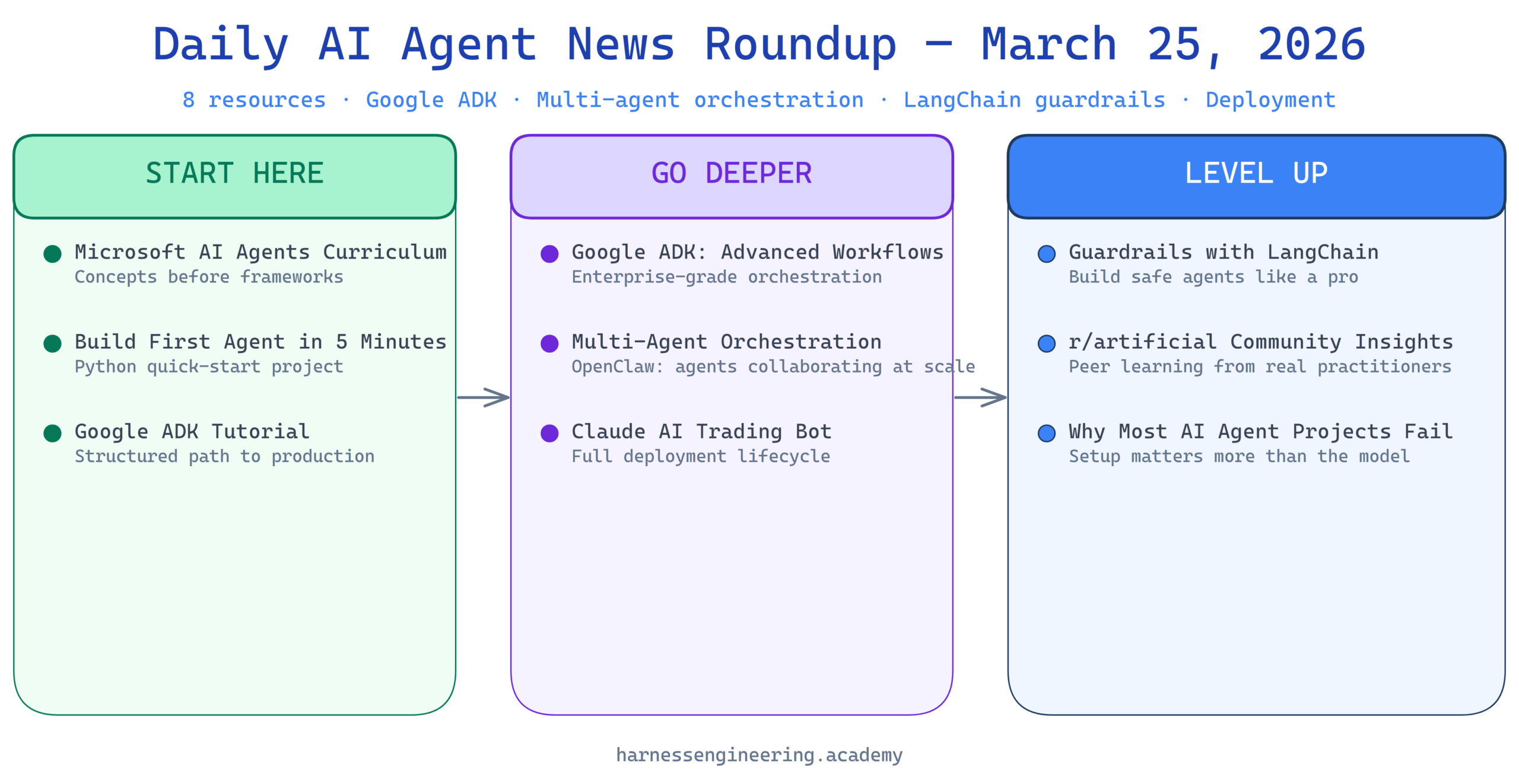
If you’re a complete beginner: Start with Microsoft’s AI Agents for Beginners (conceptual foundation) → the 5-minute Claude agent builder (confidence boost) → Google ADK tutorial (structured learning).
If you have some Python experience: Jump to Google ADK → then explore multi-agent orchestration with OpenClaw → deep-dive into the trading bot tutorial.
If you’re intermediate and looking to level up: Prioritize guardrails with LangChain → the Reddit discussion (peer learning) → multi-agent orchestration → the “why projects fail” video.
The bigger picture? The AI agent space is maturing rapidly. Frameworks are becoming more accessible (Google ADK, Microsoft’s curriculum). Communities are forming around best practices (guardrails, testing, deployment). Job opportunities are multiplying. This is the moment to invest in your learning.
The difference between someone who dabbles and someone who builds careers in AI agent engineering isn’t just talent—it’s intentional learning. Consume these resources strategically. Build projects. Fail fast. Learn from the community. Repeat.
You’ve got this. Now go build something amazing.
Stay tuned for tomorrow’s roundup. In the meantime, pick one resource from today’s list and dive in. Let me know what you learn in the comments below!
Have a great news item or tutorial to recommend for tomorrow’s roundup? Share it in the community forum or reach out to me directly.