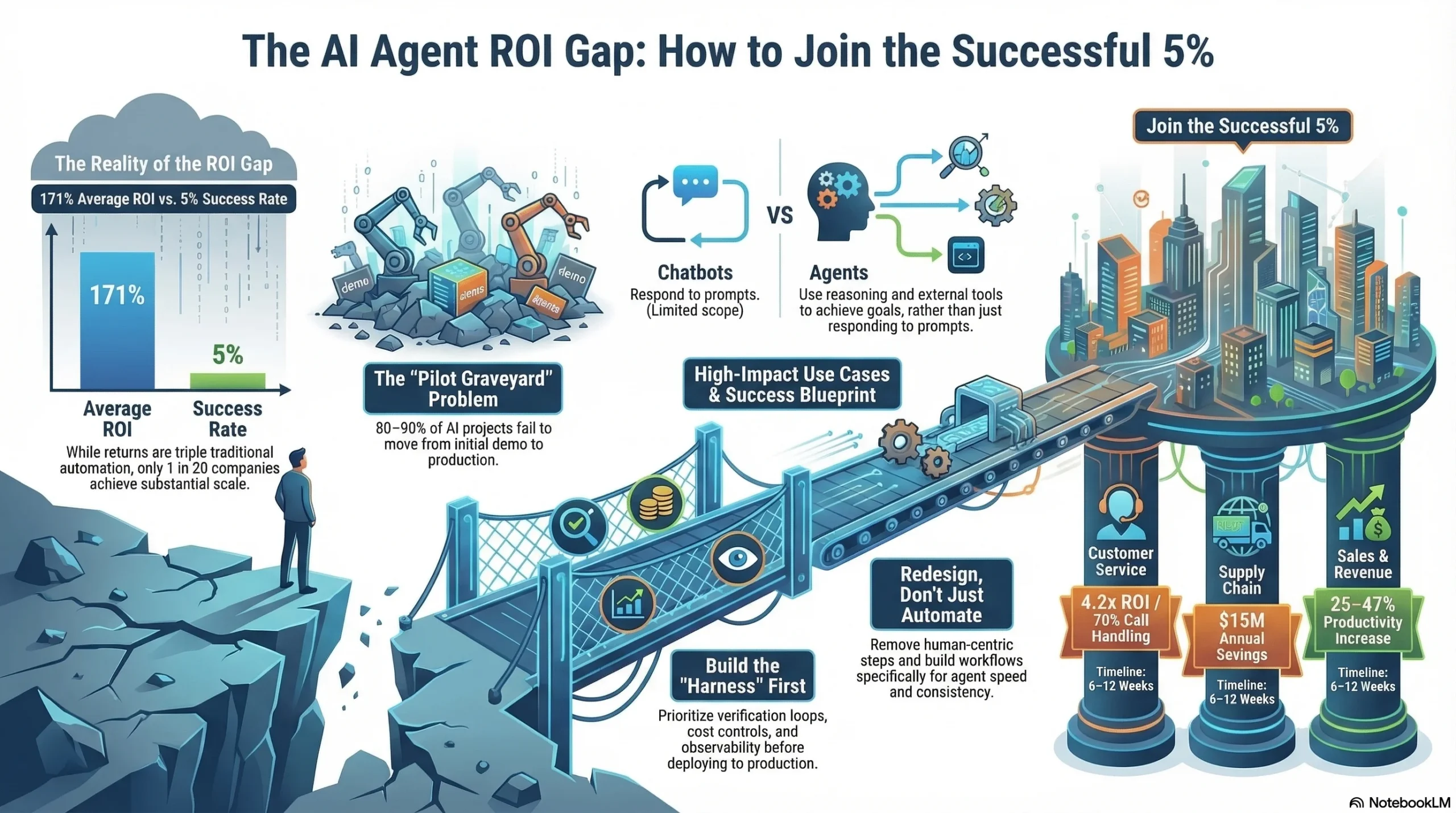
The headline number is 171% ROI. PwC surveyed enterprises deploying agentic AI and found that US organizations average 192% returns, roughly three times higher than traditional automation. The other number, buried in a BCG study of 1,250 companies, is that only 5% of enterprises achieve substantial AI ROI at scale.
Both numbers are accurate. The gap between them is not luck or budget size. It is infrastructure, process redesign, and the discipline to implement AI agents as production systems rather than science projects.
This guide covers what AI agents for business actually do, which use cases deliver measurable returns, what they really cost, why most organizations fail, and what the successful 5% do differently. If you are evaluating AI agents for your organization, the data here will save you from the pilot graveyard where 80-90% of AI projects end up.
Subscribe to our newsletter for weekly production patterns and enterprise AI implementation insights.
Interactive Concept Map
Click any node to expand or collapse. Use the controls to zoom, fit to view, or go fullscreen.
What AI Agents Actually Do for Business
An AI agent is not a chatbot with a better prompt. Chatbots respond to queries within a single conversation turn. Traditional RPA follows predefined rules and breaks when conditions change. AI agents operate differently: they pursue goals, reason through multi-step problems, use external tools, and adapt when their initial approach fails.
The distinction matters because it determines what problems agents can solve. A chatbot can answer a customer question. An RPA bot can move data between two systems. An AI agent can investigate a customer complaint, check order history across three systems, determine the root cause, apply the appropriate resolution policy, and escalate to a human only when the situation exceeds its authority.
This goal-directed behavior is what creates business value, and what creates risk. An agent that can reason its way to a solution can also reason its way into an expensive mistake. The infrastructure that wraps around the agent, the harness, determines which outcome you get.
Gartner projects that 40% of enterprise applications will feature task-specific AI agents by 2026, up from less than 5% the previous year. The question is no longer whether to deploy agents. It is how to deploy them without joining the 95% that fail to scale.
Seven Use Cases That Actually Deliver ROI
Not all agent use cases are equal. Some deliver measurable returns within weeks. Others require months of integration work before showing results. The use cases below are organized by proven ROI data from production deployments, not vendor marketing.
Customer Service and Support
This is the most validated use case for AI agents in business. Ninety percent of CX leaders report positive ROI from agent deployments, according to industry surveys. A major telecom company achieved 4.2x ROI by handling 70% of inbound customer calls with AI agents.
The agents do not just answer questions. They access customer history, check order status across systems, apply return and refund policies, and route complex cases to human specialists with full context attached. The measurable impact is not just cost reduction but faster resolution times and higher customer satisfaction scores.
Timeline to ROI: 6-12 weeks for initial deployment; measurable cost reduction within the first quarter.
Financial Operations and Fraud Detection
Mastercard processes over 100 billion transactions annually using AI agents for fraud detection. Financial services organizations report 43% operational efficiency gains from agent deployments, with use cases spanning Know Your Customer verification, loan underwriting automation, and real-time regulatory compliance monitoring.
The agents excel here because financial operations involve high-volume, rule-intensive decisions where speed and accuracy directly translate to revenue. A fraud detection agent that catches suspicious transactions 200 milliseconds faster across billions of transactions produces enormous value.
Timeline to ROI: 12-20 weeks for integration with financial systems; ROI typically within two quarters.
Supply Chain and Procurement
Danfoss automated 80% of its purchase orders using AI agents, reducing response times from 42 hours to near real-time. The result: $15 million in annual savings with a six-month payback period.
Supply chain agents handle inventory optimization, dynamic routing when disruptions occur, demand forecasting, and supplier evaluation. The ROI is measurable because procurement and logistics have clear cost baselines. When you can quantify the cost per purchase order before and after automation, the business case writes itself.
Timeline to ROI: 6-12 weeks for task automation; payback within 3-6 months for focused deployments.
Healthcare Operations
Healthcare shows one of the strongest per-dollar returns: $3.20 for every $1 invested within 14 months, according to industry data. Agent use cases include clinical documentation automation, care coordination across provider networks, revenue cycle management, and prior authorization processing.
Mayo Clinic and other major health systems have moved from pilot to production with agents handling administrative workflows that previously consumed clinician time. The ROI compounds because every hour of administrative work returned to clinicians has a high opportunity cost.
Timeline to ROI: 12-20 weeks for clinical workflow integration; measurable impact within 14 months.
Sales and Revenue Operations
Sales teams report 25-47% productivity increases with AI agent deployments. Agents handle lead scoring and prioritization, prospect research and outreach personalization, pipeline analysis and deal forecasting, and CRM data hygiene.
The key insight from production deployments: agents that automate research and preparation tasks (spending 20 minutes gathering context on a prospect before a call) deliver more value than agents that try to automate the actual selling.
Timeline to ROI: 6-12 weeks for CRM integration; productivity gains visible within the first month.
HR and Talent Management
Organizations report 75% reduction in time-to-hire with AI agents handling candidate screening, interview scheduling, and initial assessment. Agents also address employee onboarding automation, benefits question resolution, and attrition prediction with early intervention.
The ROI calculation is straightforward: cost per hire multiplied by positions filled annually, compared to the agent deployment cost. For organizations hiring at volume, the payback period is often measured in weeks.
Timeline to ROI: 6-12 weeks for ATS integration; measurable in the next hiring cycle.
Legal and Compliance
Legal professionals save 240 hours annually per person with AI agents handling contract review, regulatory change monitoring, due diligence research, and compliance documentation. At typical legal billing rates, this translates to significant cost savings even for small legal teams.
Timeline to ROI: 12-20 weeks for document system integration; annual savings measurable after one quarter.
Use Case Summary
| Use Case | Key ROI Metric | Timeline to ROI | Complexity |
|---|---|---|---|
| Customer Service | 4.2x ROI, 70% call handling | 6-12 weeks | Low |
| Financial Operations | 43% efficiency gains | 12-20 weeks | Medium |
| Supply Chain | $15M annual savings (Danfoss) | 6-12 weeks | Medium |
| Healthcare | $3.20 per $1 invested | 12-20 weeks | High |
| Sales | 25-47% productivity increase | 6-12 weeks | Low |
| HR & Talent | 75% hiring time reduction | 6-12 weeks | Low |
| Legal & Compliance | 240 hours saved per person/year | 12-20 weeks | Medium |
The Real Cost of AI Agents
Every vendor pitch includes the ROI. None of them include the full cost. Here is what AI agents for business actually cost in production.
Direct Agent Costs
The agent itself is the smallest line item. Depending on complexity, agent platforms and API costs run $10-$500 per month. Compare this to a contractor at $3,000-$8,000 per month or a full-time employee at $5,000-$15,000 per month including benefits. The unit economics look compelling, and they are, if you stop here.
Implementation Costs
Initial implementation runs $5,000-$25,000 for a single focused use case, with monthly operating expenses of $200-$1,000. This covers prompt engineering, tool integration, testing, and initial deployment.
| Cost Category | AI Agent | Contractor | Full-Time Employee |
|---|---|---|---|
| Monthly cost | $10-$500 | $3,000-$8,000 | $5,000-$15,000 |
| Availability | 24/7 | Business hours | Business hours |
| Scale | Instant | Weeks to hire | Months to hire |
| Implementation | $5K-$25K one-time | Training period | Onboarding period |
The Costs Nobody Mentions
Integration and compliance account for 40-60% of total cost, not the model itself. Multi-agent systems consume roughly 15 times the tokens of single-agent systems. Monitoring infrastructure ($5,000-$10,000 upfront) saves $30,000 or more in rework and incident costs.
The production deployment infrastructure that makes agents reliable, including verification loops, cost controls, observability, and graceful degradation, is where the real investment goes. Teams that skip this infrastructure are the ones who end up in the 95% that fail to scale.
A realistic total cost for a single focused use case: $15,000-$50,000 in year one, including infrastructure. For multi-agent enterprise deployments: $100,000-$500,000 depending on complexity and integration depth.
Why 95% of Enterprises Fail to Scale AI Agents
BCG studied 1,250 companies and found that only 5% achieve substantial AI ROI at scale. A RAND study puts it more bluntly: 80-90% of AI projects never leave the pilot phase. Gartner projects that 40% of agentic AI projects will be canceled by 2027.
The pilot-to-production gap is the defining challenge of enterprise AI agents. Pilot numbers nearly doubled in a single quarter, from 37% to 65%, but full deployment remains stagnant at 11%. Organizations can demonstrate possibility. They cannot demonstrate operational reliability.
The Five Failure Modes
Scattered experiments. Organizations run dozens of disconnected pilot projects across different departments with no shared infrastructure. Each team builds its own agent from scratch. Nothing scales because nothing was designed to scale.
Layering AI onto existing workflows. The most common mistake. Teams take an existing process, add an agent to one step, and expect transformation. The process was designed for humans. Agents need redesigned processes that account for their strengths (speed, consistency) and weaknesses (hallucination, context drift).
No infrastructure investment. Teams build the agent and skip the harness. No verification loops to catch tool call failures. No cost controls to prevent runaway spending. No observability to debug production issues. The agent works in staging and fails in production because production is messy, variable, and unforgiving.
Missing executive co-ownership. BCG found that 62% of AI value flows to core business functions when executives co-own the implementation. Without executive sponsorship that ties agent deployment to business process redesign, agents become IT projects disconnected from business outcomes.
No measurement discipline. Over 50% of finance executives cannot clearly demonstrate ROI from AI initiatives. The problem is not that agents lack value. It is that organizations lack the measurement infrastructure to isolate agent impact from overall business performance.
Klarna’s experience illustrates the risk of moving too fast. Their all-AI customer service approach generated significant customer backlash, demonstrating that agent capabilities and organizational readiness are separate problems.
What the 5% Do Differently
The companies achieving durable returns from AI agents for business follow a pattern that BCG calls “ruthless prioritization.” It is not about having better models or bigger budgets. It is about implementation discipline.
Step 1: Start With One Contained Workflow
Pick a single workflow where the inputs are well-defined, the outputs are measurable, and the failure mode is recoverable. Invoice processing, ticket routing, and report generation are strong candidates. “Transform customer experience” is not a starting point. “Automate tier-one ticket classification and routing” is.
Step 2: Redesign the Process
Do not automate the existing workflow. Redesign it for agents. This means defining explicit decision criteria, building in verification checkpoints, creating escalation paths, and removing steps that only existed because humans needed them (like copy-pasting data between screens).
Step 3: Build the Harness First
Before the agent writes its first production response, build the infrastructure around it. This is what we call harness engineering: verification loops that validate every tool call, cost controls that prevent runaway spending, observability that traces every decision, and fallback mechanisms that degrade gracefully when the agent fails.
The agent harness is what separates a demo from a production system. Teams that invest here first report dramatically higher success rates than teams that add infrastructure after problems emerge.
Step 4: Measure a Single KPI for 12 Weeks
Do not track 15 metrics. Pick the one that matters most for the business case: cost per ticket resolution, processing time per invoice, or error rate on classification. Measure it daily for 12 weeks. This gives you enough data to distinguish real improvement from variance.
Step 5: Scale Based on Validated Results
Expand only when the data supports it. Move to adjacent workflows first, not entirely new domains. Reuse the harness infrastructure you built. Each subsequent deployment should be faster and cheaper than the first because you are building on proven infrastructure rather than starting from scratch.
Implementation Timeline: What to Expect
Implementation timelines vary dramatically by agent complexity. Vendors quote weeks. Reality often takes months. Here are calibrated timelines from production deployments.
Task automation agents handle structured, repetitive work: document processing, data entry, ticket classification. Expect 6-12 weeks to deployment and 40-70% cost reduction once operational. These are the fastest path to ROI and the right starting point for most organizations.
Decision support agents augment human judgment: flagging anomalies, recommending actions, summarizing complex information. Expect 12-20 weeks to deployment and 25-40% quality improvement in decision outcomes. These require more integration depth and human-in-the-loop design.
Autonomous decision agents operate independently within defined boundaries: dynamic pricing, real-time fraud detection, automated procurement. Expect 16-28 weeks to deployment and 50-80% cost reduction once operational. These require the most robust harness infrastructure and the longest validation periods.
Most organizations achieve payback within 3-6 months on focused initial deployments. Full organizational scale, the kind that delivers the headline 171% ROI number, takes 2-4 years. This is significantly longer than the 7-12 months typical for traditional IT projects, and organizations that plan for the shorter timeline consistently underinvest in infrastructure.
Frequently Asked Questions
What is the average ROI of AI agents for business?
Organizations report an average 171% return on agentic AI investments, with US enterprises averaging 192%. These numbers come from PwC surveys of enterprises with production deployments. The critical caveat: only 5% of enterprises achieve substantial ROI at scale. The median experience is significantly lower than the average.
Which business function should deploy AI agents first?
Customer service consistently delivers the fastest and most measurable ROI, with 90% of CX leaders reporting positive returns. It combines high volume, clear success metrics, and recoverable failure modes. Start with ticket classification and routing before attempting end-to-end resolution.
How much does it cost to implement AI agents?
For a single focused use case: $15,000-$50,000 in year one including agent costs, implementation, and production infrastructure. Multi-agent enterprise deployments range from $100,000-$500,000. The agent itself is the smallest cost; integration and infrastructure account for 40-60% of total spend.
Can small businesses benefit from AI agents?
Yes, but the approach is different. Small businesses should start with off-the-shelf agent platforms for specific tasks like customer support or scheduling rather than building custom agents. At $10-$500 per month for the agent platform, the cost is accessible. The key is choosing a vendor with built-in harness capabilities so you don’t need to build infrastructure yourself.
What infrastructure do I need before deploying AI agents?
At minimum: API access to the tools your agent will use, a monitoring system to track agent behavior and costs, verification logic to validate agent outputs, and an escalation path to human operators. This is the basic agent harness. For production deployments, add cost controls, distributed tracing, and automated evaluation pipelines.
The Bottom Line
The ROI data for AI agents in business is real. Organizations that get implementation right see returns that dwarf traditional automation. But the gap between the 171% headline and the 95% failure rate is not a mystery. It is infrastructure.
The organizations that succeed treat agent deployment as an engineering discipline, not a procurement decision. They redesign processes, build robust harness infrastructure, measure ruthlessly, and scale only when the data supports it.
Three steps to start this week:
- Identify one workflow where you can measure cost per unit of work today. That measurement baseline is your foundation.
- Read the complete guide to agent harness engineering to understand the infrastructure layer that makes agents reliable in production.
- Subscribe to the newsletter for weekly production patterns, implementation case studies, and enterprise deployment lessons from teams running agents at scale.
The technology is ready. The question is whether your organization’s implementation discipline matches your ambition.