So you have decided you want to build AI agents. Maybe you watched a demo of an autonomous coding assistant, or you read about a company running entire workflows without a human in the loop, or you simply want to future-proof your engineering career. Whatever brought you here — welcome. You have picked the right time to start.
Here is the honest truth: you do not need to build everything from scratch. The AI agent ecosystem has matured remarkably fast, and today there are purpose-built development kits — frameworks, SDKs, and toolkits — that handle the hard plumbing so you can focus on building the actual agent behavior that matters for your project.
This guide is your complete introduction to those tools. We will cover what AI agent development kits actually are, what goes inside them, which ones are worth your attention, and how to choose the right one for your first project. By the end, you will have a working mental model, a concrete comparison of the top frameworks, and a beginner-friendly example to get your hands dirty.
Let’s build something.
What Is an AI Agent Development Kit?
An AI agent development kit (sometimes called an agent SDK or agent framework) is a collection of pre-built software components, abstractions, and utilities designed to help you construct AI agents faster and more reliably than writing everything from scratch.
Think of it like this: if you wanted to build a house, you could theoretically make your own bricks, mill your own timber, and forge your own nails. But you would never actually finish the house. Instead, you use pre-made materials and standard tools so you can focus on the design and construction decisions that actually matter.
Agent development kits work the same way. They give you the “materials” for the most common agent engineering challenges — connecting to AI models, managing conversation memory, calling external tools, orchestrating multi-step plans — so you can spend your energy on the logic that makes your agent genuinely useful.
Why Do Development Kits Matter?
Before these frameworks existed, building even a simple multi-step AI agent required writing hundreds of lines of custom code to handle:
- Sending messages back and forth to a language model API
- Parsing the model’s response to figure out whether it wanted to call a tool
- Executing that tool call and feeding the result back to the model
- Keeping track of the full conversation history without overflowing the model’s memory limit
- Handling errors, retries, and edge cases at every step
That is a lot of undifferentiated engineering work. Agent development kits package those solutions so that you can define your agent’s tools and goals in a few dozen lines of code and let the framework handle the rest.
For beginners especially, this is transformative. You can go from “I have never built an agent before” to “I have a working agent running in my terminal” in an afternoon.
Key Components of a Typical Agent Development Kit
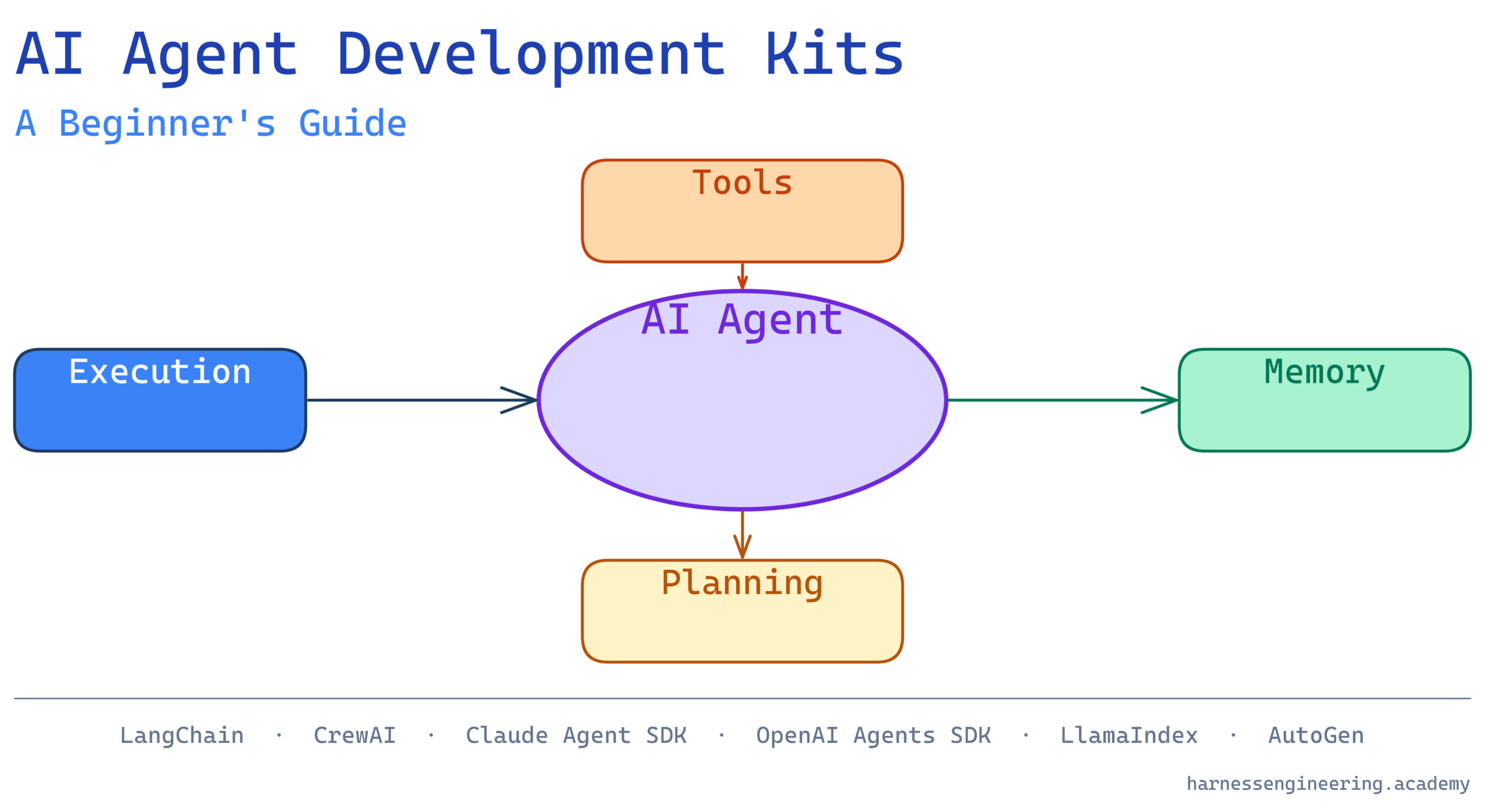
Every major agent framework, regardless of the specific API it exposes, is built around the same four fundamental components. Understanding these will help you read documentation, evaluate frameworks, and debug your agents when things go wrong.
1. Tools
Tools are the actions an agent can take in the world beyond just generating text. Without tools, an agent can only think — it cannot do anything. Tools are what give agents their power.
Common tool types include:
- Web search — retrieve current information from the internet
- Code execution — run Python, JavaScript, or other code and return the output
- File system access — read and write files on disk
- API calls — interact with external services (weather APIs, databases, calendar systems)
- Browser control — navigate web pages and extract information
In most frameworks, you define a tool by writing a function and giving it a name and description. The agent’s reasoning model reads those descriptions and decides when to call each tool based on the current task. The clearer and more specific your tool descriptions, the more reliably your agent will use them correctly.
2. Memory
Memory determines how much context an agent retains across steps and sessions. This is one of the trickiest components to get right, and one of the most important for building agents that feel coherent and intelligent.
Most frameworks support at least two layers of memory:
- Short-term (in-context) memory — the conversation history passed directly to the model on each turn. This is fast but limited by the model’s context window size.
- Long-term (external) memory — information stored outside the model in a database or vector store, retrieved when relevant. This allows agents to “remember” information across sessions or at volumes too large to fit in context.
Some frameworks also support episodic memory (a record of past agent runs) and semantic memory (a structured knowledge base the agent can query).
3. Planning
Planning is the process by which an agent breaks a complex goal into a sequence of smaller steps and decides how to execute them. This is what separates a simple chatbot from a genuine AI agent.
Different frameworks implement planning in different ways:
- ReAct (Reason + Act) — the agent alternates between reasoning about the current situation and taking an action, step by step.
- Chain-of-Thought — the agent is prompted to think through a problem before responding, producing better reasoning for complex tasks.
- Task decomposition — the agent explicitly breaks the goal into sub-tasks before starting execution.
- Multi-agent planning — one “planner” agent creates a task list that specialist “worker” agents then execute in parallel or in sequence.
4. Execution
Execution is the runtime layer that actually runs the agent loop: sending messages to the model, routing tool calls, collecting tool results, and deciding when the task is complete. A well-designed execution layer handles retries, error recovery, logging, and safe termination so your agent does not run forever or take unintended actions.
Many frameworks also include execution features like human-in-the-loop checkpoints (pausing the agent to ask a human before taking a sensitive action) and guardrails (automatic checks that prevent certain outputs or actions).
Popular AI Agent SDKs and Frameworks
Here is an honest comparison of the most widely used agent development kits as of early 2026. Each one has a different design philosophy and a different sweet spot.
LangChain
Best for: Beginners who want a rich ecosystem and lots of examples
LangChain is the original and still the most widely adopted agent framework. It provides abstractions for chains (sequences of LLM calls), agents (LLM-driven decision loops), and a vast library of pre-built tool integrations covering everything from web search to SQL databases to document loaders.
LangChain’s greatest strength is its ecosystem. There are tutorials, Stack Overflow answers, YouTube videos, and community examples for virtually every use case. If you get stuck, someone else has already been stuck in the same place and posted a solution.
Its weakness is complexity. LangChain has undergone significant API changes over its lifetime, and its abstractions can feel like they are adding layers rather than removing them when you are doing something simple. That said, for a first serious agent project, it remains an excellent starting point.
Language: Python (primary), JavaScript/TypeScript (LangChain.js)
Open source: Yes
AutoGen (Microsoft)
Best for: Multi-agent systems where agents collaborate through conversation
AutoGen, developed by Microsoft Research, takes a distinctly different approach: it treats agent collaboration as a conversational protocol. Agents are defined as entities that can send and receive messages from each other, and complex workflows are built by orchestrating those conversations.
This model makes AutoGen particularly good for scenarios where you want multiple specialized agents working together — a researcher, a writer, a critic, a coder — each handling the part of the task it is best at. AutoGen handles the message routing, conversation management, and termination conditions.
Language: Python
Open source: Yes
CrewAI
Best for: Teams and role-based multi-agent workflows
CrewAI is a newer framework that has gained rapid adoption for its intuitive mental model: you define a “crew” of agents, each with a role, a goal, and a set of tools, and then you define tasks and assign them to crew members. The framework handles the orchestration.
This role-based abstraction maps naturally onto real-world workflows. A marketing content pipeline might have a ResearchAgent, a WriterAgent, a ReviewerAgent, and a PublisherAgent. CrewAI makes defining and connecting those roles feel natural even for developers new to multi-agent design.
Language: Python
Open source: Yes
Anthropic Claude Agent SDK
Best for: Production agents built on Claude models, with a focus on safety and structured tool use
Anthropic’s Claude Agent SDK is purpose-built for constructing agents around Claude models. It provides first-class support for tool use, multi-turn conversations, computer use (allowing agents to interact with desktop interfaces), and structured output. Anthropic has invested heavily in making Claude reliable for agentic tasks — Claude is trained specifically to recognize when to call tools, when to ask for clarification, and when to stop.
The SDK shines for production use cases where predictability and safety matter. Anthropic’s emphasis on AI safety is reflected in features like built-in support for human-in-the-loop confirmation flows and careful handling of ambiguous instructions.
Language: Python, TypeScript
Open source: SDK is open source; Claude models are accessed via API
OpenAI Agents SDK
Best for: Developers already in the OpenAI ecosystem who want a lightweight, official framework
OpenAI released its own Agents SDK in 2025, providing a streamlined way to build agents on top of GPT-4o and related models. The SDK’s design philosophy emphasizes simplicity: minimal abstractions, direct access to model capabilities, and easy integration with the OpenAI Assistants API for persistent threads and file storage.
If your organization is already using OpenAI’s APIs and you want an officially supported framework without heavy dependencies, the OpenAI Agents SDK is a natural choice.
Language: Python, TypeScript
Open source: Yes
LlamaIndex
Best for: Agents that need to reason over large document collections (RAG-heavy use cases)
LlamaIndex started as a data indexing library for retrieval-augmented generation (RAG) and has evolved into a full agent framework. Its sweet spot remains agents that need to query and reason over large corpora — internal knowledge bases, document libraries, code repositories.
If your agent needs to answer questions grounded in specific documents, LlamaIndex’s data connectors, indexing pipelines, and query engines are among the most mature in the ecosystem.
Language: Python (primary), TypeScript
Open source: Yes
Framework Comparison at a Glance
| Framework | Best For | Multi-Agent | RAG Support | Beginner Friendly | License |
|---|---|---|---|---|---|
| LangChain | General purpose, rich ecosystem | Yes | Yes | High | MIT |
| AutoGen | Conversational multi-agent | Yes (native) | Limited | Medium | MIT |
| CrewAI | Role-based team workflows | Yes (native) | Yes | High | MIT |
| Claude Agent SDK | Production agents, safety-focused | Limited | Yes | Medium | MIT |
| OpenAI Agents SDK | OpenAI ecosystem, simple projects | Basic | Yes | High | MIT |
| LlamaIndex | RAG-heavy, document reasoning | Yes | Excellent | Medium | MIT |
Step-by-Step: Choosing the Right Kit for Your Project
With so many options, how do you actually pick one? Here is a practical decision process that I walk beginners through.
Step 1: Clarify Your Goal
Before you evaluate any framework, write one sentence that describes what your agent will do. Examples:
- “My agent will answer questions about our internal documentation.”
- “My agent will research a topic, write a summary, and email it to me each morning.”
- “My agent will help users book appointments by checking availability and sending confirmations.”
This clarity matters because different frameworks excel at different shapes of problem.
Step 2: Identify Your Constraints
Ask yourself:
- Which AI model am I using? If you are committed to Claude, the Claude Agent SDK will give you the tightest integration. If you are using GPT-4o, OpenAI’s SDK is natural. If you want flexibility, LangChain and LlamaIndex support many models.
- Do I need multiple agents working together? If yes, look at CrewAI or AutoGen first.
- Is my primary challenge large document retrieval? If yes, LlamaIndex is likely your best starting point.
- How much complexity can I handle right now? If you are genuinely new to this, start with LangChain or CrewAI — the documentation and community support will save you significant frustration.
Step 3: Run a Quick Prototype
Do not commit to a framework based on documentation alone. Take the framework you think is the best fit and spend two hours building the smallest possible version of your agent. Did the framework’s abstractions feel natural? Did you hit walls early? Was the error messaging helpful?
Two hours of prototyping will tell you more than two days of reading.
Step 4: Check the Long-Term Fit
Consider: Is this framework actively maintained? Does it have a clear roadmap? Is there a community you can turn to when you get stuck? Frameworks that were cutting-edge six months ago can fall behind quickly in this field — a quick check of recent GitHub commits and community activity is worth the five minutes.
Building a Simple Agent: A Beginner-Friendly Example
Let’s make this concrete. Here is how you would build a minimal research agent using the OpenAI Agents SDK — an agent that can search the web and summarize what it finds.
This example assumes you have Python installed and a valid OpenAI API key set as the OPENAI_API_KEY environment variable.
Install the SDK
pip install openai-agents
Define Your Tools
import httpx
from agents import Agent, Tool, Runner

def search_web(query: str) -> str:
    """
    Search the web for a given query and return a text summary of results.
    In production, replace this with a real search API (Tavily, Brave, etc.).
    """
    # Placeholder: returns a simulated search result
    return f"Search results for '{query}': [Article 1: ...], [Article 2: ...]"

# Wrap the function as a Tool the agent can call
web_search_tool = Tool(
    name="search_web",
    description="Search the web for current information on a topic. Use this when you need up-to-date facts.",
    function=search_web,
)
Define and Run Your Agent
# Define the agent's persona and goal
research_agent = Agent(
    name="ResearchAgent",
    instructions="""
    You are a helpful research assistant. When given a topic,
    use the search_web tool to find relevant information,
    then synthesize a clear, well-structured summary.
    Always cite where your information came from.
    """,
    tools=[web_search_tool],
    model="gpt-4o",
)

# Run the agent with a user request
result = Runner.run_sync(
    research_agent,
    "What are the most significant AI agent frameworks released in the last year?"
)

print(result.final_output)
What Just Happened?
When you run this code, the framework:
- Sends your question to GPT-4o along with the agent’s instructions and the tool definition
- GPT-4o decides it should call
search_webwith a relevant query - The framework executes
search_web, gets the result, and feeds it back to GPT-4o - GPT-4o synthesizes the search results into a final response
- The framework returns that response to you
That entire reasoning loop — the back-and-forth between the model and the tool — happened automatically. You defined the goal, the tools, and the instructions. The framework handled the rest.
From here, you could extend this agent with additional tools (a file writer, a PDF reader, an email sender), connect it to real search APIs, add persistent memory across sessions, or deploy it as a web service. Every one of those extensions is a learnable next step.
Career Paths: How Learning These Kits Advances Your Career
This is not just a technical skill — it is a career accelerator. The demand for engineers who can design, build, and deploy AI agents is growing faster than the supply of people who know how to do it well. Here is what that means for you.
Roles That Directly Use These Skills
- AI Agent Engineer — Designs and builds autonomous AI agent systems. One of the fastest-growing job titles in software engineering right now.
- LLM Application Developer — Builds production applications on top of large language models, including agentic features.
- AI Automation Engineer — Implements agentic workflows that automate business processes, a role appearing in companies of every size.
- ML Platform Engineer — Builds and maintains the infrastructure that supports AI agent deployment at scale.
- AI Product Manager — Does not write agent code directly but needs deep understanding of what agents can and cannot do to make good product decisions. Framework fluency is a major differentiator here.
How These Skills Layer Into a Learning Path
Think of your learning journey in three phases:
Phase 1 — Foundations (0–3 months): Learn how LLMs work, understand prompt engineering, and build your first tool-using agent with a beginner-friendly framework like LangChain or the OpenAI Agents SDK. Focus on understanding the agent loop deeply, not on covering every framework.
Phase 2 — Depth (3–9 months): Go deep on one framework. Build real projects. Learn memory management, error handling, and multi-step planning. Start exploring multi-agent patterns with CrewAI or AutoGen. Deploy an agent to a real endpoint.
Phase 3 — Breadth and Specialization (9+ months): Expand your framework knowledge. Learn evaluation and testing for agent systems. Develop a specialty — RAG-heavy agents, multi-agent orchestration, safety and alignment, or infrastructure. Start contributing to open-source projects or publishing your work.
At each phase, the frameworks in this guide are your primary vehicle for learning. They are not just tools — they are the curriculum.
The Salary Picture
AI agent engineers with a year or two of hands-on framework experience are commanding salaries that were previously reserved for senior backend engineers or ML researchers. That is a reflection of genuine supply-demand dynamics, not hype. Organizations are racing to build agentic systems and are finding that people who actually know how to build them are rare.
The engineers who build those skills now — while the field is still young enough that you can learn from public documentation and open-source examples — will be the ones who define what this field looks like in five years.
Tips for Getting Started
Here is practical advice I give to every new student who asks where to begin.
Pick One Framework and Stick With It (At First)
The temptation when you discover how many frameworks exist is to spend weeks comparing them all before writing any code. Resist that. Pick one — my recommendation for most beginners is LangChain (broadest ecosystem) or CrewAI (most intuitive mental model for multi-agent work) — and build three real projects with it before you evaluate alternatives. Depth beats breadth in the early stages.
Build Projects, Not Tutorials
Tutorials are a starting point, not a destination. After you complete a tutorial, close the guide and rebuild the project from memory. Then extend it: add a new tool, add memory, make it do something slightly different. That gap between “following instructions” and “applying knowledge” is where the real learning happens.
Read the Source Code
All of the frameworks in this guide are open source. When something behaves unexpectedly, read the framework’s source code rather than only searching for answers. You will learn more in twenty minutes of reading well-written framework code than in two hours of Stack Overflow searches — and you will understand the framework at a level most practitioners never reach.
Join the Communities
LangChain, CrewAI, AutoGen, and the Anthropic and OpenAI developer communities all have active Discord servers, GitHub discussions, and forums. The people building these frameworks are often directly accessible. When you get stuck on something genuinely tricky, asking in the right community can get you an authoritative answer in hours.
Do Not Wait Until You Feel Ready
The most common mistake I see from aspiring AI agent engineers is waiting until they have “learned enough” before building something real. You will never feel ready before you start. Build something small, make it work, break it, understand why it broke, and fix it. That cycle — not any amount of reading — is how engineers are made.
Conclusion: Your First Agent Is Closer Than You Think
AI agent development kits have made what was once genuinely difficult — building autonomous, tool-using AI systems — accessible to any developer willing to put in the time to learn. You do not need a PhD. You do not need to work at a frontier AI lab. You need curiosity, a willingness to build things and break them, and a clear understanding of the components that make agents work.
You now have that understanding.
You know what agent development kits are and why they exist. You know the four core components — tools, memory, planning, and execution — that every framework builds around. You have a clear comparison of the leading options and a step-by-step process for choosing among them. You have a working code example you can run today. And you have a clear picture of the career path that opens up when you develop these skills seriously.
The only thing left is to start.
Ready to go deeper? Explore our AI Agent Engineering Fundamentals course — a beginner-friendly, project-based curriculum that takes you from your first agent to production-ready systems in just a few weeks. No prior AI experience required.
Or browse our free tutorials library for hands-on guides on specific frameworks, tool patterns, memory architectures, and multi-agent design. Every tutorial is written to take you from concept to working code.
The engineers who understand how to build AI agents — really build them, with production-quality reliability — are going to be among the most valuable professionals of the next decade. You are already on that path.
Let’s keep building.
Written by Jamie Park, Educator and Career Coach at Harness Engineering Academy. Jamie specializes in beginner-to-advanced AI agent tutorials with a focus on practical, career-relevant skills.