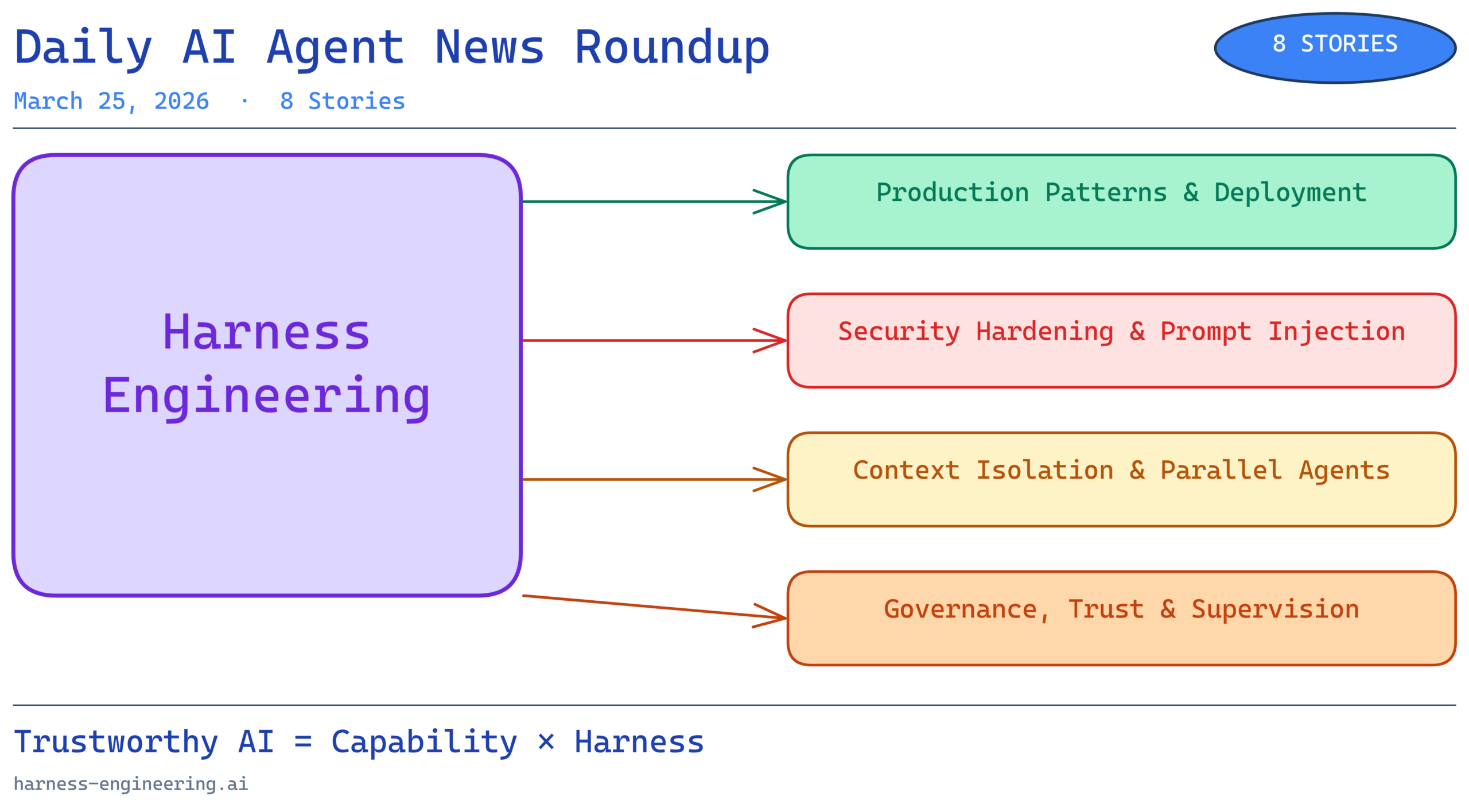
The first quarter of 2026 has fundamentally shifted how the industry approaches AI agents. We’ve moved past the chatbot era into serious production deployments, which means the focus has sharply pivoted toward harness engineering—the discipline of building reliable, verifiable, and operationally sound AI agent systems. Today’s news cycle reflects this maturation: lessons from production teams, security vulnerabilities that demand architectural responses, context management strategies for parallel operations, and the emergence of agentic automation in enterprise workflows.
What strikes me most is how the conversation has evolved. Two years ago, we debated whether AI agents were viable. Today, the debate centers on how to build them correctly—testing strategies, prompt injection defenses, context isolation, and supervision frameworks. That shift is the story of harness engineering.
1. Lessons From Building and Deploying AI Agents to Production
This session distills hard-won lessons from teams running agents in production, covering integration patterns, failure modes, and operational monitoring that separates aspirational agent systems from ones that actually work at scale. The content synthesizes experiences across multiple organizations, creating a practical blueprint for avoiding common pitfalls in deployment.
Harness Engineering Perspective: The real value here isn’t in discovering new techniques—it’s in codifying the patterns that separate experimental agents from production systems. This is the harness layer: monitoring hooks, graceful degradation paths, fallback mechanisms when agents exceed their capabilities, and observability that surfaces agent reasoning chains for post-incident analysis. Production teams deploying agents need infrastructure that lets them answer “why did this agent take this action?” in seconds, not days. That’s harness.
2. Test Your AI Agents Like a Hacker – Automated Prompt Injection Attacks
As agents become more autonomous, adversarial testing has shifted from theoretical exercise to operational necessity. This piece covers automated prompt injection detection and red-teaming frameworks specifically designed to break agent behavior through malicious inputs embedded in data sources, user requests, or tool outputs. The approach treats agents as security perimeters that need active defense.
Harness Engineering Perspective: Prompt injection isn’t a chatbot problem anymore—it’s an architectural problem for autonomous systems. If an agent can be reliably tricked into executing unintended actions through crafted inputs, your harness has failed. This demands layered verification: input validation at agent boundaries, behavior verification against declared intent, and kill-switches that pause execution when confidence drops below thresholds. Advanced systems use prompt injection as a test signal—if your agent can be manipulated, your harness needs tighter coupling between declared goals and actual execution. Security isn’t bolt-on; it’s core to reliable harness design.
3. AI Agents Just Went From Chatbots to Coworkers
Major announcements from industry leaders signal a decisive shift: agents are moving from customer-facing chatbots into internal workflow automation and collaborative work alongside humans. The implication is profound—agents are no longer aspirational productivity tools, but integrated components of business processes where reliability directly impacts operations.
Harness Engineering Perspective: This transition is precisely why harness engineering matters. A chatbot that occasionally hallucinates is a UX problem. An agent embedded in your approval workflow that occasionally approves the wrong thing is a business and compliance problem. The move to “coworker” status means agents now need reliability guarantees that rival traditional software systems. That requires: strict capability boundaries (declaring what agents can and cannot do), human-in-the-loop checkpoints at high-risk decision points, and comprehensive audit trails for every action. The harness isn’t about making agents smarter—it’s about making them trustworthy at whatever intelligence level they operate.
4. How I Eliminated Context-Switch Fatigue When Working with Multiple AI Agents in Parallel
Managing multiple agents simultaneously without cognitive overload is emerging as a practical challenge. This discussion covers context isolation strategies, shared state management, and coordination patterns that prevent agents from interfering with each other or creating conflicting state.
Harness Engineering Perspective: This is a classic harness problem. The underlying issue is context leakage—when one agent’s state, reasoning, or side effects inadvertently influence another agent’s execution. Solving this requires architectural discipline: separate context boundaries for each agent, explicit state passing mechanisms rather than implicit shared memory, and verification that agents maintain isolation guarantees even under parallel execution. This is why banking systems have been doing this for decades (transaction isolation, ACID guarantees). We’re now applying those same principles to AI systems. The harness here includes: context managers that enforce isolation, deadlock detection when agents wait on each other, and observability that shows you exactly what state each agent has access to at each moment.
5. Microsoft Just Launched an AI That Does Your Office Work for You — Built on Anthropic’s Claude
Copilot Cowork represents the mainstream arrival of autonomous office automation. The system handles routine workflows in productivity tools, from email triage to meeting scheduling to document drafting. The fact that this ships with governance controls (approval workflows, audit logging, capability restrictions) signals that the industry has learned the lesson: unleashed automation creates liability.
Harness Engineering Perspective: Notice what Copilot Cowork ships with: not raw agent capability, but harness infrastructure around that capability. The controls aren’t afterthoughts—they’re central to the product. This is the right mental model. In production, the harness matters more than the underlying model. A 70-billion parameter model constrained by proper supervision can be more trustworthy than a 100-billion parameter model running unchecked. Enterprise deployments need: human approval workflows for high-impact actions, role-based capability restrictions, comprehensive audit trails for compliance, and explicit fallback behaviors when agents encounter situations outside their training. These aren’t features—they’re requirements for agents in regulated domains.
6. Building AI Coding Agents for the Terminal: Scaffolding, Harness, Context Engineering
This deeply technical session focuses on agents that operate in code environments, specifically the terminal. The emphasis on scaffolding and harness engineering reveals how successful teams structure agent execution: providing agents with safe sandboxes, explicit tool boundaries, and verification mechanisms that catch errors before they propagate.
Harness Engineering Perspective: Terminal-based agents are inherently high-stakes—a misexecuted command can delete production data. The session’s focus on scaffolding is exactly right. Scaffolding is the harness: it includes restricted execution environments, dry-run capabilities that let agents preview actions without committing them, and rollback mechanisms. Advanced patterns include: agents that generate commands, then have those commands reviewed before execution; verification layers that validate command syntax and safety before running; and context managers that isolate filesystem access. This is where we see harness engineering at its most mature—treating agent actions as untrusted until verified, building defensive infrastructure as a first principle rather than an afterthought.
7. Harness Engineering: Supervising AI Through Precision and Verification
This session directly addresses the core discipline: what does it mean to supervise AI systems such that they remain reliable, predictable, and auditable? The focus on precision (agents behaving exactly as constrained) and verification (continuous validation that behavior matches intent) articulates the harness philosophy.
Harness Engineering Perspective: This is the canonical statement of what harness engineering is. It’s not about making agents more capable—it’s about making agents more supervise-able. Supervision requires: clear specification of intended behavior, instrumentation that surfaces actual behavior, continuous verification that actual matches intended, and automated rollback when they diverge. The precision angle is crucial: an agent that approximates your intent 95% of the time and surprises you 5% of the time is less useful than an agent with 60% capability but 99.9% predictability. Production systems need the latter. That requires discipline at every level: in prompt engineering (clarity over complexity), in tool design (narrow, well-defined actions), in monitoring (comprehensive signal coverage), and in feedback loops (rapid detection of drift).
8. AI Agents: Skill & Harness Engineering Secrets REVEALED!
This short-form piece captures an essential distinction: skill engineering (improving what agents can do) versus harness engineering (ensuring agents do it safely and reliably). The reframing is valuable because it stops treating harness as a constraint and starts treating it as the enabler.
Harness Engineering Perspective: The insight here is that without harness, skill doesn’t matter. A skilled agent running unchecked is a liability. With harness, skill can be effectively deployed. This is the product equation: Trustworthy AI = Capability × Harness. You can’t compromise on either. We’ve spent years optimizing for capability (larger models, more tokens, better training data). The 2026 inflection point is optimizing for harness—the infrastructure, tooling, and architectural patterns that let you deploy capable agents safely. That includes: automated testing frameworks specific to agent behavior, monitoring systems that surface anomalies, governance layers that enforce policy, and human feedback loops that refine behavior over time.
The Harness Engineering Moment
What unites today’s news isn’t technology—it’s philosophy. Every item reflects a maturation: moving from “can we build AI agents?” to “how do we build them responsibly?” That maturation is harness engineering.
The practical implications are significant:
-
Architecture matters more than raw capability. A well-designed harness amplifies agent effectiveness; poor harness design undermines it.
-
Verification is non-negotiable. In production, you need continuous signals that agents are doing what you intended, and automated rollback when they’re not.
-
Context isolation is fundamental. Multiple agents, complex workflows, and high-stakes decisions all require strict boundaries.
-
Governance and capability are entangled. You can’t separate agent autonomy from supervision—they’re two sides of the same coin.
-
Security is architectural. Prompt injection, jailbreaks, and adversarial inputs aren’t edge cases—they’re primary concerns that should shape system design.
As we move deeper into 2026, the teams winning with AI agents aren’t the ones with the most sophisticated models. They’re the ones with the most mature harness engineering practices—clear boundaries, comprehensive monitoring, automated safety checks, and human oversight that scales with agent autonomy.
That’s where the real work is. That’s where the production patterns emerge. That’s harness engineering.
Dr. Sarah Chen is a Principal Engineer at Harness Engineering AI, focused on production patterns, reliability architecture, and system design for autonomous AI systems. Follow daily roundups for analysis of the evolving AI agent landscape.