Executives approve AI agent projects based on vendor promises. They cancel them based on CFO questions. The disconnect is measurement: most organizations can’t answer “what did we get for the money we spent?” because they never established what they were measuring.
The AI agent ROI numbers floating around the industry tell a contradictory story. PwC reports 171% average ROI. BCG reports that 95% of enterprises fail to achieve ROI at scale. Both numbers are real. The difference is in the measurement framework: organizations that measure rigorously tend to invest wisely. Organizations that don’t tend to chase demos.
This guide provides the measurement framework, the specific formulas, and the realistic cost data you need to build an honest AI agent business case.
Interactive Concept Map
Click any node to expand or collapse. Use the controls to zoom, fit to view, or go fullscreen.
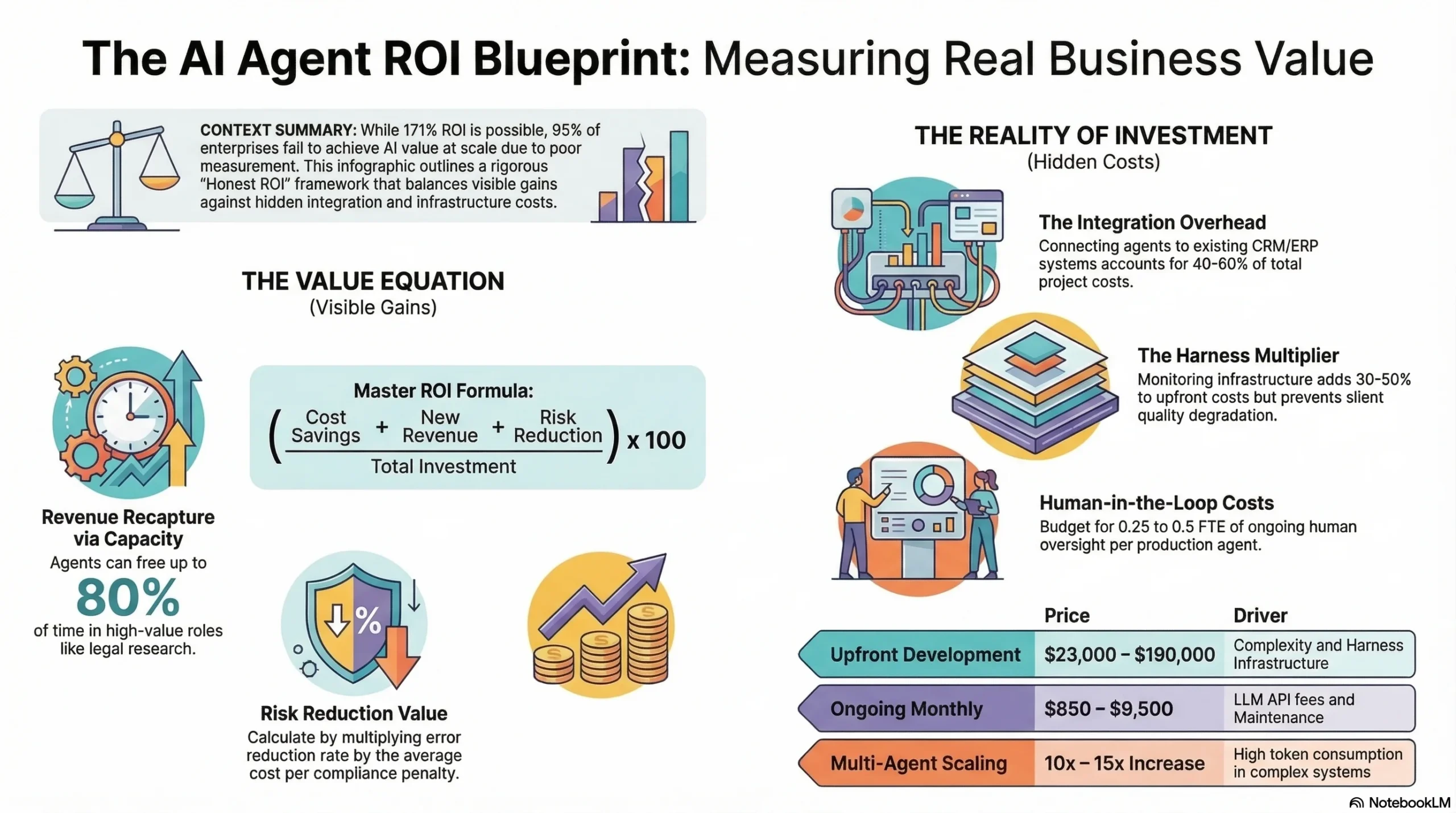
The ROI formula
AI agent ROI follows a straightforward formula:
ROI = (Cost Savings + New Revenue + Risk Reduction) / Total Investment x 100
The formula is simple. The hard part is accurately measuring each component.
Cost savings
The most measurable value driver. Cost savings come from automating tasks that humans currently perform.
How to calculate:
- Identify the process the agent will handle
- Measure current cost: (hours per task) x (fully loaded hourly rate) x (tasks per year)
- Estimate agent completion rate (what percentage of tasks the agent handles without human intervention)
- Calculate savings: current cost x agent completion rate – agent operating cost
Example: A support team handles 100,000 tickets per year at $8 per ticket ($800,000 annual cost). An AI agent deflects 60% of tickets. Remaining human cost: $320,000. Agent operating cost: $110,000 per year. Net savings: $370,000.
New revenue
Harder to measure but often larger than cost savings. New revenue comes from capacity unlocked by agent automation.
How to calculate:
- Identify bottlenecked capacity (sales team can’t follow up on all leads, legal team can’t bill all available hours)
- Measure current utilization: how much capacity is consumed by tasks the agent could handle
- Estimate freed capacity that converts to revenue
- Calculate revenue: freed hours x revenue per hour x conversion rate
Example: 50 attorneys spend 10 hours weekly on research at a billable rate of $250/hour. An AI research agent reduces research time by 80%, freeing 8 hours per attorney per week. If 50% of freed hours convert to billable work: 50 attorneys x 8 hours x 50% x $250 x 50 weeks = $2.5 million in additional revenue capacity.
Risk reduction
The hardest to quantify but often the argument that tips executive decisions. Risk reduction includes fewer errors, better compliance, and reduced exposure to regulatory penalties.
How to calculate:
- Identify error-prone processes the agent will handle
- Estimate current error rate and cost per error (rework time, customer churn, compliance penalties)
- Estimate agent error rate (typically lower for structured tasks, potentially higher for novel situations)
- Calculate risk reduction: (current error rate – agent error rate) x cost per error x annual volume
The real cost of AI agents
Most ROI analyses underestimate costs by 40-60%. Here’s what a realistic cost breakdown looks like.
Upfront costs
| Cost Category | Range | Notes |
|---|---|---|
| Agent development | $5,000 – $100,000 | Depends on complexity: simple chatbot vs multi-agent system |
| Harness infrastructure | $10,000 – $50,000 | Verification, monitoring, cost controls, logging |
| Integration | $5,000 – $25,000 | Connecting to existing systems and data sources |
| Testing and evaluation | $3,000 – $15,000 | Building evaluation datasets, setting up testing pipelines |
| Total upfront | $23,000 – $190,000 |
Ongoing monthly costs
| Cost Category | Range | Notes |
|---|---|---|
| LLM API costs | $200 – $5,000 | Scales with usage volume and model choice |
| Infrastructure hosting | $100 – $1,000 | Compute, storage, databases |
| Monitoring and observability | $50 – $500 | LangSmith, Langfuse, or custom tooling |
| Maintenance and updates | $500 – $3,000 | Prompt tuning, model updates, bug fixes |
| Total monthly | $850 – $9,500 |
Hidden costs most analyses miss
Integration overhead. Connecting agents to existing systems (CRM, ERP, databases) typically accounts for 40-60% of the total project cost. The agent itself is the easy part. Making it talk to your existing infrastructure is the expensive part.
Harness engineering. The verification loops, cost controls, and monitoring that make agents production-ready add 30-50% to development costs but reduce ongoing maintenance costs by 60-80%. Organizations that skip harness investment upfront pay more in incident response and quality issues later.
Human oversight. Even highly automated agent systems require human review for edge cases, model updates, and quality audits. Budget for 0.25-0.5 FTE of ongoing human oversight per production agent system.
Multi-agent scaling. Token consumption in multi-agent systems scales 10-15x compared to single-agent systems. A single-agent prototype costing $500/month in API fees can become a $5,000-$7,500/month multi-agent production system.
Three ROI scenarios with real numbers
Scenario 1: Customer support agent (High confidence ROI)
| Metric | Value |
|---|---|
| Current annual support cost | $800,000 (100K tickets at $8/ticket) |
| Agent development + harness | $110,000 |
| Annual operating cost | $60,000 |
| Ticket deflection rate | 60% |
| Annual savings | $370,000 |
| Year 1 ROI | 218% |
| Payback period | 4 months |
Customer support is the highest-confidence AI agent use case because outcomes are measurable (ticket deflection rate, resolution time, customer satisfaction), the task is well-defined, and the volume justifies the investment.
Scenario 2: Legal research agent (High return, higher risk)
| Metric | Value |
|---|---|
| Current annual research cost | $6.5M (50 attorneys x 10 hrs/week x $250/hr) |
| Agent development + harness | $196,000 |
| Annual operating cost | $96,000 |
| Research time reduction | 80% |
| Revenue recapture (50% of freed time) | $2.5M |
| Year 1 ROI | 756% |
| Payback period | 1 month |
The numbers look dramatic, but the risk is higher. Legal research agents must be verified rigorously because incorrect legal citations can lead to malpractice. The harness investment (verification, citation checking, human review loops) is what makes this ROI achievable rather than theoretical.
Scenario 3: Supply chain optimization (Long-term play)
| Metric | Value |
|---|---|
| Current annual inefficiency cost | $5M |
| Agent development + harness | $490,000 |
| Annual operating cost | $240,000 |
| Efficiency improvement | 20% |
| Annual savings | $1M |
| Year 1 ROI | 37% |
| Payback period | 8 months |
Supply chain agents have lower first-year ROI but compound over time as the system learns and optimizes. Year 2 and beyond typically sees 2-3x the Year 1 improvement without proportional cost increases.
The measurement framework
Measuring AI agent ROI requires establishing baselines before deployment, not after. Follow this timeline:
Before deployment (Month 0): Document current process costs, error rates, cycle times, and volume. These baselines are your comparison points. Without them, you’re guessing.
Months 1-3: Measure direct metrics: task completion rate, deflection rate, cost per task, error rate. Compare against baselines.
Months 3-6: Add indirect metrics: employee satisfaction (are they freed from drudgery?), customer satisfaction (is the agent’s quality acceptable?), time-to-resolution.
Months 6-12: Measure compound effects: has the agent improved over time? Has freed capacity converted to revenue? Have error rates continued declining?
Annually: Compare total investment (including hidden costs) against total value (savings + revenue + risk reduction). Adjust the model and recalibrate expectations.
When AI agents are NOT worth the investment
Not every process benefits from agent automation. These signals suggest the ROI won’t materialize:
Low volume. If the process handles fewer than 1,000 tasks per year, the development investment rarely pays off. The fixed costs of building and maintaining an agent system need high volume to amortize.
Poor data quality. Agents that need information from poorly maintained databases, inconsistent formats, or manual spreadsheets will spend more time failing than succeeding. Fix the data quality first.
Minimal time savings. If the agent saves less than 30 minutes per employee per week, the productivity gain is too small to measure and too small to justify the investment.
Novel judgment required. Tasks that require genuinely novel judgment on every instance (strategic planning, creative direction, relationship management) aren’t strong agent candidates. Agents excel at structured, repeatable tasks with clear success criteria.
The harness multiplier
Organizations that invest in harness engineering see measurably different ROI outcomes than organizations that don’t. The pattern is consistent:
- Without harness infrastructure: Agent works for 2-4 weeks, then quality degrades silently. Costs spike from stuck loops. Team loses confidence and abandons the project. ROI: negative.
- With harness infrastructure: Verification catches quality issues early. Cost controls prevent runaway spending. Monitoring surfaces problems before users notice. Team iterates on a stable foundation. ROI: 3-6x in year one.
The harness doesn’t generate value directly. It protects the value the agent generates. An agent without a harness is a depreciating asset. An agent with a harness is a compounding one.
For the full picture on building production-grade agent systems, read our deployment guide and testing methodology.
Frequently asked questions
What is a good ROI target for an AI agent project?
Projects should deliver 3-5x returns within 12-18 months to justify the investment. Customer-facing agents (support, sales) typically achieve this faster than internal process agents. If your projected ROI is less than 2x in year one, either the use case isn’t strong enough or the implementation cost is too high.
How do I convince my CFO to invest in AI agents?
Start with cost savings, not revenue potential. CFOs trust expense reduction numbers more than revenue projections because they’re easier to measure and verify. Present the baseline cost, the projected savings, the investment required, and the payback period. Include the hidden costs. The more honest your analysis, the more credible your proposal.
Should I build or buy an AI agent?
Building gives you control and customization but requires engineering investment. Buying (platforms like Salesforce Agentforce, ServiceNow) gives you faster time-to-value but limits customization and creates vendor dependency. For core business processes that are competitive differentiators, build. For standard operational tasks, evaluate buy options first.
How do I measure ROI for agents that prevent errors rather than save time?
Track error rates before and after agent deployment. Multiply the error reduction by the average cost per error (rework time, customer churn, compliance penalties). This gives you a concrete dollar value for risk reduction. Many organizations find that error prevention ROI exceeds time-saving ROI, especially in regulated industries.
Subscribe to the newsletter for weekly production patterns, cost analysis frameworks, and enterprise deployment strategies.
2 thoughts on “AI Agent ROI Calculator: Measuring the Business Value of Agent Systems”