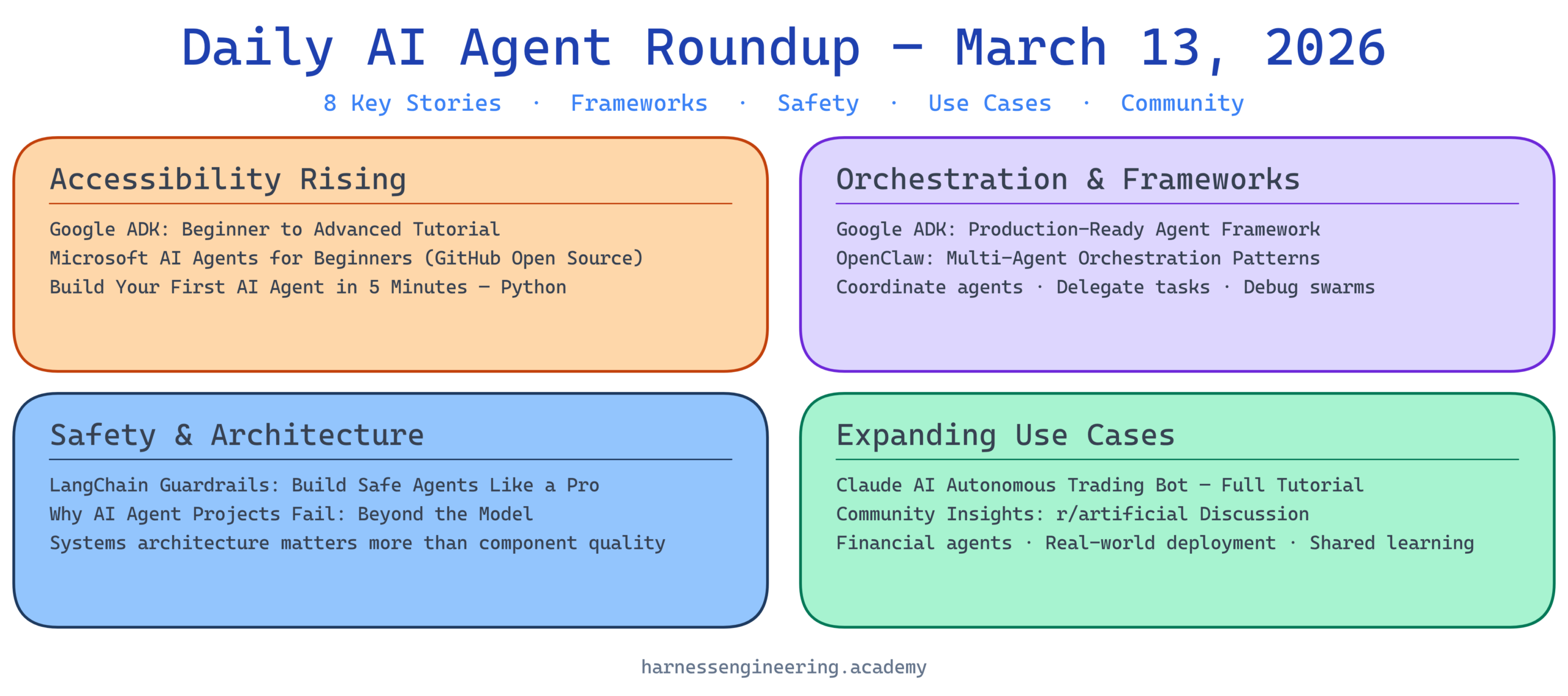
The AI agent landscape continues to evolve at a breakneck pace, with new frameworks, tutorials, and best practices emerging daily. As more developers recognize the transformative potential of autonomous AI systems, educational resources and practical guides are becoming essential for bridging the gap between theory and implementation. Today’s roundup covers everything from foundational tutorials to advanced orchestration patterns, reflecting the growing democratization of agent-building technology.
Key Stories
1. Google ADK Tutorial: Build AI Agents & Workflows from Scratch (Beginner to Advanced)
Source: YouTube
Google’s Agent Development Kit (ADK) is emerging as a comprehensive framework for building production-ready AI agents, with new tutorial content providing developers a structured path from fundamentals to advanced patterns. This resource addresses a critical gap in the market, where developers often struggle to bridge the gap between simple prototypes and enterprise-grade agent systems. The tutorial’s progression through beginner to advanced topics makes it particularly valuable for teams looking to implement agents across their organization.
Analysis: Google’s entry into standardized agent development tooling signals the maturation of this space. With their backing, the ADK has potential to become an industry standard similar to how TensorFlow dominated deep learning frameworks. For development teams already invested in Google’s ecosystem, this represents a natural evolution path. However, the competitive landscape matters—this positions Google against open-source frameworks and other cloud providers’ offerings.
2. Microsoft’s AI Agents for Beginners
Source: GitHub – microsoft/ai-agents-for-beginners
Microsoft’s beginner-focused lesson repository provides structured, hands-on learning content for developers entering the AI agent field. The open-source approach and GitHub-based delivery make it highly accessible, with the added benefit of community contributions and iterative improvements. As demand for AI agent expertise skyrockets, Microsoft’s commitment to foundational education positions them as a serious player in democratizing agent development.
Analysis: The timing is strategic. Microsoft’s investment in OpenAI and their own Copilot infrastructure means they have strong incentives to build a developer community comfortable with agent patterns. By providing free, accessible educational content, they’re cultivating long-term customer loyalty. The beginner-focused angle is particularly smart—most tutorials assume some baseline knowledge, creating a barrier to entry that this resource explicitly removes.
3. Build Your First AI Agent in 5 Minutes | Agentic AI Course | Python Project
Source: YouTube
This rapid-fire tutorial targets the growing segment of developers who want to validate the concept of AI agents quickly without extensive setup overhead. The five-minute window makes this accessible for quick learning sessions during breaks or commutes, democratizing entry into agentic AI. Quick-start guides like this serve an important function in the learning journey—they build confidence and demonstrate feasibility before learners commit to deeper study.
Analysis: The appeal of rapid tutorials reflects a broader trend: developers want to experience tangible results immediately. However, there’s a trade-off between speed and depth. While five-minute builds are excellent for proof-of-concept and motivation, production systems require far more careful design. Smart learners will use this as a gateway to more comprehensive resources rather than as the foundation for real applications.
4. Deploy Your Own AI Agent Trading Bot Using Claude Full Tutorial
Source: YouTube
Autonomous trading systems represent one of the most compelling and financially motivated use cases for AI agents, and comprehensive deployment guides are fueling interest in this space. This tutorial takes developers beyond theory, providing end-to-end guidance for building trading bots powered by Claude’s advanced reasoning capabilities. The financial sector’s early adoption of agents creates both opportunities and risks that developers should carefully consider.
Analysis: Trading bots represent the intersection of AI sophistication and real financial impact—a combination that attracts both legitimate developers and bad actors. Comprehensive, responsible tutorials are valuable because they establish best practices and safety considerations alongside technical implementation. However, anyone building trading systems should understand that agent-based trading introduces new failure modes: rapid feedback loops, unforeseen market interactions, and edge cases that can be costly. This content is most valuable when paired with rigorous testing and risk management frameworks.
5. Multi Agent Orchestration with OpenClaw
Source: YouTube
As AI agents become more sophisticated, the challenge of coordinating multiple agents toward shared goals is becoming increasingly important. OpenClaw’s approach to multi-agent orchestration provides frameworks for managing agent interaction, communication, and task delegation. This represents a evolution from single-agent systems to swarm-like architectures where agents specialize and coordinate.
Analysis: Multi-agent orchestration is where AI agents truly become powerful—individual agents have limitations, but coordinated systems can tackle dramatically more complex problems. However, this introduces new challenges: how do you ensure agents don’t conflict? How do you debug emergent behavior? How do you maintain observability across a system of autonomous actors? OpenClaw’s contribution here is significant because orchestration is the frontier where many agent projects will stumble next. Understanding these patterns now will be valuable as the technology matures.
6. Learning and Building AI Agents
Source: Reddit – r/artificial
The Reddit discussion on AI agents captures grassroots enthusiasm and practical questions from developers building agents in real-world scenarios. These community conversations often reveal the gaps between tutorial content and production reality, surfacing common pain points and creative solutions. The diversity of perspectives in these threads—from beginners to experienced practitioners—makes them valuable resources for anyone looking to understand the current state of agent development.
Analysis: Community forums like Reddit are where the true bleeding edge of development lives. While official documentation and tutorials lag behind practice, Reddit captures what developers are actually building and struggling with. Common themes in these discussions typically revolve around tool integration, reliability, and cost management. For teams building agents seriously, monitoring these discussions provides early warning of emerging best practices and pitfalls.
7. Guardrails with LangChain 🚀 Build Safe AI Agents Like a Pro
Source: YouTube
Safety and guardrails are becoming essential considerations as AI agents move from experimental projects to production deployments. This LangChain-focused tutorial addresses a critical gap: how do you constrain agent behavior to operate within acceptable boundaries? Building guardrails into agents from the beginning prevents costly mistakes and unintended behaviors in live environments.
Analysis: This content reflects a critical maturation in how developers think about agents. Early agent implementations sometimes viewed guardrails as optional—a “nice to have” for preventing misuse. Modern approaches correctly position guardrails as foundational architecture. The emphasis on LangChain is strategic, as it’s become the de facto standard orchestration framework for LLM-based agents. Developers should view guardrail implementation not as a constraint on capability, but as essential infrastructure that enables safer, more trustworthy agent deployment.
8. Why AI Agent Projects Fail: Beyond the Model Quality
Source: YouTube
While foundation models capture most of the attention, agent project failures often stem from poor setup, architecture decisions, and integration patterns rather than model limitations. This resource provides crucial perspective by shifting focus from “which model should we use?” to “how should we structure our agent systems?” Understanding failure modes is often more valuable than understanding success cases.
Analysis: This is perhaps the most important content in today’s roundup. The industry’s obsession with model quality can lead teams to overlook foundational engineering challenges: prompt engineering, memory management, tool integration, error handling, and observability. A team using GPT-4 Mini with excellent architecture will outperform a team using the latest frontier model with poor setup. The best developers recognize that agent success is a systems problem, not a model problem.
Key Takeaways
The AI agent field is experiencing a phase of rapid democratization and skill development. Several patterns emerge from today’s news:
1. Accessibility is Improving: From Google, Microsoft, and countless community contributors, foundational resources are making agent development accessible to developers at all levels. The five-minute tutorials and beginner courses represent a significant barrier reduction.
2. Production Considerations are Maturing: The emphasis on guardrails, safety, orchestration, and failure prevention shows the field is moving beyond “can we build agents?” to “how do we build agents responsibly and reliably?”
3. Use Cases are Expanding: From trading bots to multi-agent systems, the diversity of agent applications is broadening. This expansion drives both innovation and the need for more specialized knowledge.
4. Systems Thinking Matters: The recurring theme across resources—from orchestration to guardrails to failure analysis—is that agent success depends on systems architecture, not just component quality.
For development teams entering or expanding their agent capabilities, today’s landscape offers excellent resources. The combination of official frameworks from major cloud providers, community learning resources, and mature orchestration patterns creates a strong foundation. However, success requires pairing technical learning with thoughtful architecture decisions, production safeguards, and realistic expectations about the challenges ahead.
What trends are you seeing in AI agent development? Share your insights in the comments below.