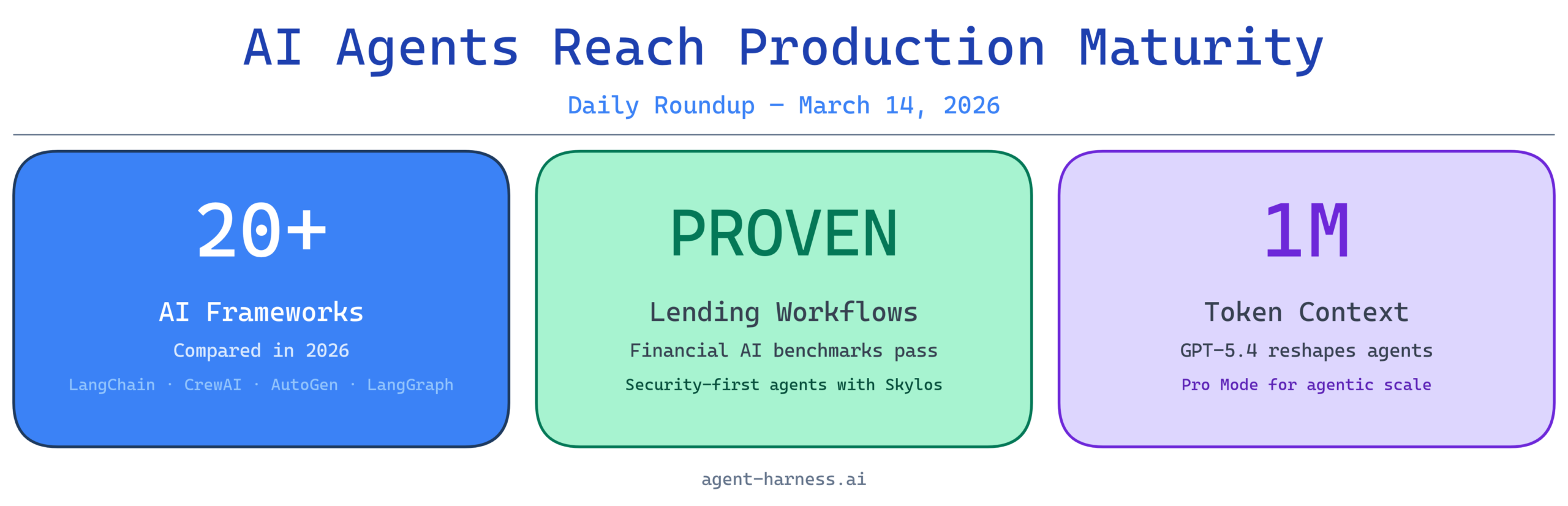
The AI agent ecosystem continues to accelerate with major framework releases, comprehensive benchmarking studies, and significant capability upgrades from leading AI providers. This week brings clarity on framework maturity, real-world performance validation, and transformative context window expansions that could reshape how agents are built and deployed. Here are the most important developments you need to know.
1. LangChain Solidifies Position as Industry Standard
LangChain’s GitHub repository continues to see massive adoption and community engagement, reflecting its dominance in the AI agent development landscape. As one of the most-forked and most-starred frameworks in the space, LangChain remains the de facto starting point for developers building production agent systems. The framework’s comprehensive tooling ecosystem and extensive integration library have made it the reference implementation for most agent patterns in use today.
LangChain’s prominence underscores a critical trend: while newer frameworks like LangGraph, CrewAI, and AutoGen are gaining traction for specific use cases, LangChain’s foundational role in agent engineering is unlikely to diminish. The framework’s maturity, documentation quality, and deep integration with the broader Python ecosystem make it essential infrastructure for teams building AI agents at scale. For developers choosing between frameworks, LangChain’s ecosystem advantage remains difficult to replicate.
2. Real-World Validation: AI Agents Pass Lending Workflow Tests
A comprehensive benchmarking study shared in the AI agent community documents performance results from testing AI agents on real lending workflows. This case study is significant because it moves beyond theoretical performance metrics to evaluate agent behavior in high-stakes financial services processes. The study provides empirical evidence of agent effectiveness, accuracy, and reliability when handling real lending scenarios including credit assessment, document verification, and risk evaluation.
This type of validation is crucial for the financial services industry’s adoption of AI agents. Lending institutions have strict regulatory requirements and low tolerance for errors—traditional testing methodologies have limitations when applied to agentic systems. The benchmarking study demonstrates that agents can achieve reliable performance in real-world workflows, removing a major adoption barrier for financial institutions exploring automation. Expect to see more industry-specific benchmarking studies emerge as AI agents penetrate regulated sectors.
3. Skylos Brings Security-First Approach to Agent Development
Skylos (duriantaco/skylos on GitHub) presents a differentiated approach to the growing AI security challenge by combining static analysis with local LLM agents. As concerns about prompt injection, data leakage, and adversarial attacks in agent systems increase, tools that prioritize security throughout the development lifecycle are becoming essential. Skylos addresses this gap by enabling developers to analyze and validate agent behavior locally before deployment, reducing the risk surface associated with remote API calls and external dependencies.
The tool reflects a broader maturation trend in the agent ecosystem: as more critical systems rely on AI agents, security cannot be an afterthought. By integrating static analysis with local LLM capabilities, Skylos offers a pragmatic middle ground between security and the rapid iteration that developers expect. For teams building agents in regulated industries or handling sensitive data, this approach could become standard practice. The emergence of security-focused frameworks like Skylos suggests that the next phase of agent development will prioritize robustness and trustworthiness as core competitive differentiators.
4. Framework Landscape Crystallizes in Comprehensive 2026 Comparison
A detailed comparison of every major AI agent framework in 2026—covering LangChain, LangGraph, CrewAI, AutoGen, Mastra, DeerFlow, and 20+ others—has emerged as a valuable resource for developers navigating framework selection. The comparison reveals that different frameworks excel for different use cases: LangChain for flexibility and breadth, LangGraph for complex workflows, CrewAI for multi-agent orchestration, and AutoGen for research and enterprise deployments. Rather than consolidation around a single winner, the agent framework space appears to be maturing into a specialized ecosystem where each tool serves distinct developer needs.
This fragmentation reflects a healthy market dynamic where frameworks are optimized for specific patterns rather than trying to solve everything. However, the proliferation of options also creates decision paralysis and integration challenges for teams building production systems. The comprehensive comparison helps developers make informed choices, but it also underscores a reality: there is no universally optimal framework. Instead, teams must evaluate frameworks based on their specific requirements for scalability, observability, security, and ease of deployment. Expect framework selection to become a critical architectural decision in 2026, similar to how teams evaluate API gateways or message queues.
5. Deep Agents vs. Shallow Workflows: Understanding the Architecture Distinction
A detailed exploration of what distinguishes advanced AI coding agents from basic LLM workflows clarifies an important conceptual distinction that’s often blurred in discussions of AI agents. The distinction between simple prompt-and-response patterns and true agentic architectures—featuring planning, memory, tool use, and iterative refinement—has profound implications for both developers and businesses building with AI. Understanding this spectrum helps teams avoid the trap of implementing simple automation that claims to be an agent without actually incorporating the core capabilities that make agents powerful.
This educational content is particularly valuable because coding agents are among the most complex and high-stakes applications of agentic patterns. Coding assistants must maintain context, reason about code structure, handle errors gracefully, and iterate toward correct solutions—capabilities that deep agent architectures provide but shallow LLM wrappers cannot. As organizations invest in AI-assisted development tools, this distinction becomes critical: teams need to understand whether their tool is a productivity enhancement or a fundamental shift in how code is written. The video helps close this knowledge gap for developers and decision-makers alike.
6-8. OpenAI’s GPT-5.4 Release: 1M Token Context and Pro Mode Transform Agentic Possibilities
OpenAI’s release of GPT-5.4 with a one-million token context window represents a watershed moment for AI agent capabilities. Multiple sources covering GPT-5.4 with expanded context and broader AI updates from this week highlight how the exponential growth in context window capacity fundamentally changes what agents can accomplish. With one million tokens, agents can now maintain comprehensive project context, process entire codebases, analyze hours of conversation history, and make decisions based on vastly richer information. The addition of Pro Mode suggests OpenAI is introducing tiered pricing that recognizes the different computational requirements of agentic versus consumer applications.
The implications are far-reaching. Agents can now be deployed on problems that previously required multiple specialized tools or manual information synthesis. A coding agent with million-token context can understand an entire codebase’s architecture, maintain conversation history across long debugging sessions, and handle complex refactoring tasks with full project awareness. Financial agents can analyze comprehensive transaction histories, regulatory documents, and market data simultaneously. This capability jump will likely accelerate adoption of agentic patterns across enterprises, as the cost-benefit calculation shifts decisively toward automation. However, it also raises important questions about how developers should redesign agents to take advantage of these expanded capabilities—simply feeding everything into the context window is not optimal; strategic context management will remain crucial.
This Week’s Takeaway: The Agent Ecosystem Reaches Production Maturity
March 14, 2026 marks an inflection point in AI agent development. We’re seeing the convergence of three critical capabilities: mature frameworks optimized for different use cases, real-world validation in high-stakes domains like financial services, and transformative leaps in model capabilities (1M token context windows). The agent ecosystem is no longer experimental—it’s moving into production deployment across regulated industries.
The key insight: success in 2026 will depend less on choosing the “best” framework and more on understanding your specific requirements and selecting tools optimized for that pattern. Simultaneously, security and observability are becoming competitive advantages as agents take on more critical responsibilities. Teams that focus on understanding the distinction between shallow automation and deep agent architectures, while prioritizing security and real-world validation, will lead the next phase of AI transformation.
For practitioners: Evaluate frameworks against your specific use case rather than chasing generalist solutions. For enterprises: Begin planning how expanded context windows and Pro Mode pricing affect your cost models and agent design patterns. For all: The age of AI agents is no longer coming—it’s here. The question is not whether to adopt agents, but how to do so responsibly and effectively.