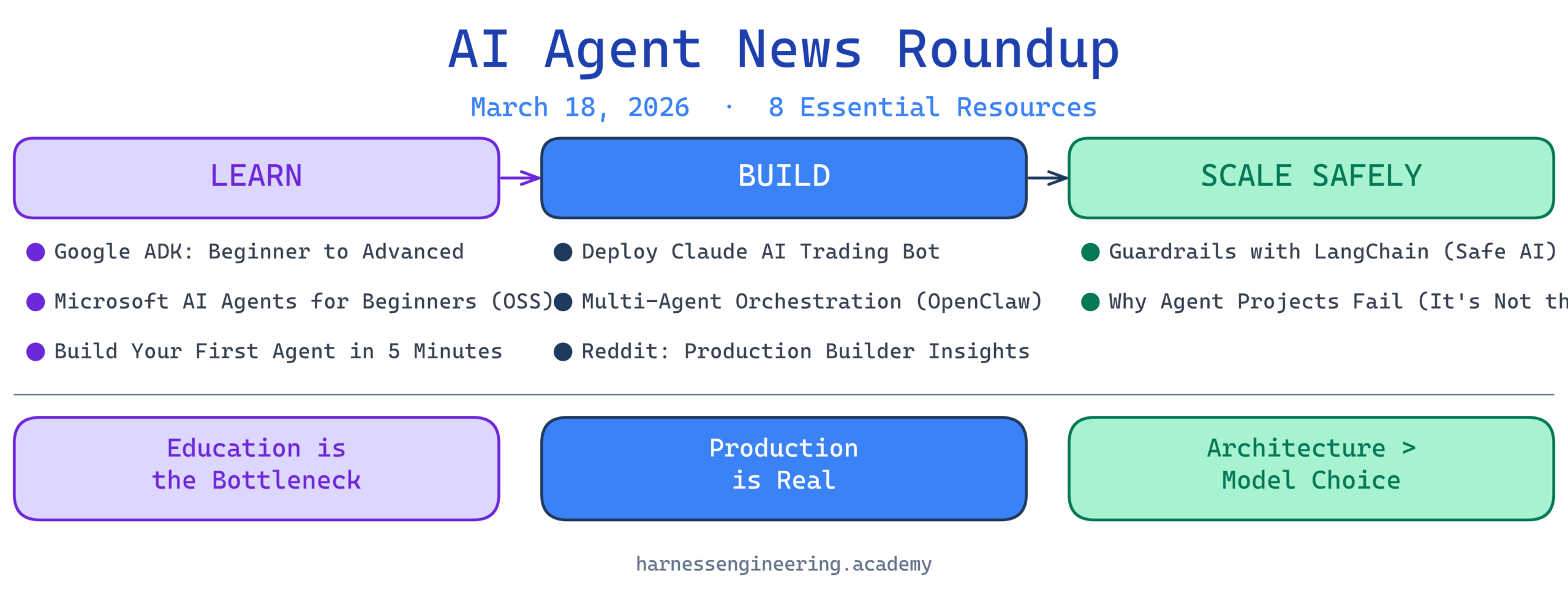
The AI agent development landscape continues to accelerate, with major players releasing comprehensive tutorials and frameworks designed to democratize agent-building for developers at all skill levels. Today’s roundup highlights essential resources for learning agentic AI, practical deployment guides, and critical insights into what separates successful agent projects from those that fail. Whether you’re just starting or scaling multi-agent systems, today’s coverage provides actionable knowledge from hands-on tutorials to architectural best practices.
1. Google ADK Tutorial: Build AI Agents & Workflows from Scratch (Beginner to Advanced)
Google’s release of the Agent Development Kit (ADK) represents a significant milestone in making AI agent development accessible to developers across all experience levels. This comprehensive tutorial walks users through building agents and workflows from foundational concepts to advanced implementations, providing a structured learning path that bridges the gap between theory and practical application.
Analysis: Google’s entry into the agent development education space signals the maturation of this field. By releasing a complete tutorial alongside the ADK, they’re acknowledging that developers need both tools and guidance to effectively build agents. The breadth of the curriculum—from beginner to advanced—suggests Google is betting on broad adoption and sees educational content as critical infrastructure for the agent economy. For organizations adopting agent technology, this represents a trusted, officially-backed resource that integrates directly with Google’s ecosystem.
2. Microsoft’s AI Agents for Beginners
Microsoft’s open-source repository delivers beginner-friendly lessons designed to lower the barrier to entry for developers new to AI agents. Available on GitHub, this resource provides structured learning materials that align with the current surge in demand for practical, accessible AI agent training.
Analysis: Microsoft’s commitment to beginner-focused content reflects a strategic push to build developer adoption for their AI agent ecosystem. By releasing free, open-source educational materials, they’re positioning themselves as a thought leader while simultaneously building a talent pipeline of developers skilled in their tools and frameworks. This approach mirrors successful developer relations strategies from other enterprise platforms, where investing in education pays dividends in tool adoption and ecosystem growth.
3. Build Your First AI Agent in 5 Minutes | Agentic AI Course | Python Project
Quick-start tutorials are increasingly popular as developers seek immediate, hands-on experience with AI agents. This five-minute tutorial removes friction from the initial learning phase, allowing developers to experience a working agent quickly before diving into more complex implementations.
Analysis: The proliferation of rapid, beginner-friendly tutorials signals a market realignment. As AI agents move from experimental to mainstream, the focus shifts from “can we build this?” to “how quickly can developers get started?” Short-form tutorials serve as entry points that, if successful, lead to deeper engagement with frameworks and production applications. For organizations developing agent platforms, these quick wins are critical for user acquisition and early-stage engagement metrics.
4. Deploy Your Own AI Agent Trading Bot Using Claude Full Tutorial
This comprehensive tutorial demonstrates a practical real-world application of AI agents in the financial technology space. The guide walks developers through building and deploying an autonomous trading bot powered by Claude, providing end-to-end implementation details from agent design to deployment.
Analysis: AI trading bots represent one of the most commercially compelling use cases for agent technology, combining autonomous decision-making with high-stakes financial outcomes. The availability of comprehensive tutorials in this domain signals both the market opportunity and the maturation of agent frameworks capable of handling real-time financial operations. However, regulatory considerations around algorithmic trading mean this content should be approached with appropriate compliance awareness. For developers with fintech experience, these tutorials open doors to new application domains for their AI expertise.
5. Multi Agent Orchestration with OpenClaw
As agent systems scale beyond single-agent implementations, orchestration becomes critical. This tutorial addresses the increasingly complex challenge of coordinating multiple agents working in concert, introducing OpenClaw as a framework for managing multi-agent workflows.
Analysis: Single-agent systems handle constrained problems; complex, real-world challenges require multiple agents with specialized capabilities. The emergence of tools specifically designed for multi-agent orchestration indicates that the field has moved past proof-of-concept phases into production-scale systems. Understanding orchestration techniques is becoming essential knowledge for architects designing agent-based solutions. The focus on this topic suggests that “multi-agent systems” is transitioning from research interest to practical necessity for enterprise deployments.
6. Learning and Building AI Agents Discussion
Community discussions on Reddit reveal practical concerns and solutions from developers actively building agents in production. This thread captures real-world challenges, including questions about scalable approaches using LLMs and tool-calling workflows, reflecting the practical experience of practitioners in the field.
Analysis: Community forums provide unfiltered insights into where developers struggle and where frameworks succeed. Reddit discussions highlight that while tutorials focus on “hello world” implementations, production-scale builders are grappling with scalability, reliability, and integration challenges. These conversations reveal gaps between what’s documented and what’s actually needed, making them invaluable for product teams building agent infrastructure. The focus on scalable LLM-based workflows and tool-calling patterns indicates these are becoming foundational architectural patterns for agent systems.
7. Guardrails with LangChain: Build Safe AI Agents Like a Pro
Safety and reliability in AI agents aren’t afterthoughts—they’re fundamental to responsible deployment. This crash course covers implementing guardrails using LangChain, teaching developers how to constrain agent behavior and prevent unwanted outcomes in production environments.
Analysis: The growing emphasis on guardrails reflects lessons learned from early agent deployments. As agents gain more autonomy and interact with real systems, failure modes become more costly. LangChain’s prominence in this tutorial indicates it’s becoming the go-to framework for adding safety constraints to agent systems. Organizations deploying agents in regulated industries or with access to critical systems need these guardrail patterns. The availability of comprehensive training on this topic signals market maturation—safety is no longer optional for production-grade agents.
8. Why AI Agent Projects Fail: It’s Usually Not the Model
This video addresses a critical blind spot in agent development: most failures stem not from model limitations but from poor project setup, architecture, and implementation. Understanding these failure modes is essential for both newcomers and experienced developers scaling agent systems.
Analysis: This message challenges the conventional wisdom that more capable models solve all problems. The reality is more nuanced—agent success depends on thoughtful design of the interaction loops, tool definitions, error handling, and monitoring infrastructure. This insight is invaluable because it redirects focus from model selection (where differences between top models are marginal) to systems design (where differences are dramatic). For organizations investing in agent projects, this suggests that engineering discipline and architectural rigor are more important differentiators than using the latest, most capable model. The focus on “why projects fail” positions this content as experience-driven wisdom that could save teams months of development effort.
Key Takeaways
March 18, 2026 highlights an inflection point in AI agent development:
Education is the bottleneck. Major platforms (Google, Microsoft) are investing heavily in beginner tutorials, signaling that developer education is now the limiting factor in agent adoption, not technical capability or availability of frameworks.
Production is real. Content spanning trading bots, multi-agent orchestration, and safety guardrails indicates agents are moving from experimental projects into production systems with real operational constraints.
Execution > model capability. The recurring theme that project failures stem from setup and architecture rather than model limitations should shift organizational focus toward systematic engineering practices and architectural rigor.
Multi-agent systems are becoming standard. The prominence of orchestration and coordination content suggests that complex problems increasingly require multiple specialized agents rather than monolithic single-agent systems.
For teams building AI agent systems, today’s resources emphasize a clear pathway: start with beginner tutorials from trusted platforms, deepen knowledge through quick-start projects, then graduate to production considerations like orchestration, safety, and architectural patterns that determine success or failure in real-world deployments.
What’s your biggest challenge in building AI agents? Share your thoughts in the comments or reach out to the Harness Engineering Academy community.