The AI agent ecosystem continues to accelerate, with new educational resources, deployment frameworks, and safety best practices emerging daily. Today’s roundup highlights the expanding toolkit for developers—from beginner-friendly introductions to production-ready orchestration strategies. Whether you’re just starting your journey into agentic AI or optimizing existing agent systems, today’s news offers critical insights into what’s working and what matters most.
1. Google ADK Tutorial: Build AI Agents & Workflows from Scratch (Beginner to Advanced)
Source: YouTube
Google has released a comprehensive tutorial on the Agent Development Kit (ADK), providing developers with a structured pathway from foundational concepts to advanced implementations. The tutorial covers end-to-end agent and workflow construction, equipping developers with both theoretical understanding and practical hands-on experience. This release addresses a critical gap in the market for production-grade educational content on agent architecture.
Analysis: Google’s entry into the agent education space signals the platform’s commitment to democratizing AI agent development. With ADK providing a framework that integrates with Google’s broader ecosystem, this positions the company as a serious contender in the agentic AI developer tooling landscape. For developers already invested in Google Cloud, this tutorial becomes an invaluable resource for avoiding reinvention and adopting proven patterns.
2. Microsoft’s AI Agents for Beginners
Source: GitHub
Microsoft has open-sourced a structured, beginner-friendly curriculum for learning AI agents, delivered through GitHub lessons and hands-on projects. The repository provides progressive lessons that scaffold complexity, making agent concepts accessible to developers without extensive AI experience. This educational resource directly addresses the growing demand for skill development in the expanding agentic AI market.
Analysis: Microsoft’s approach of using GitHub as the distribution channel ensures accessibility and community contribution potential. By open-sourcing the curriculum, Microsoft demonstrates confidence in the breadth of the agent market and positions itself as a thought leader rather than a gatekeeper. For aspiring AI engineers, this free, community-backed resource becomes essential on-ramp material.
3. Build Your First AI Agent in 5 Minutes
Source: YouTube
Quick-start guides for agentic AI are proliferating, with this 5-minute Python project serving as a rapid entry point for developers. The ultra-condensed format removes barrier-to-entry friction and demonstrates that meaningful agent functionality can be achieved without weeks of study. This approach capitalizes on the current moment when beginner enthusiasm for AI agents is at an all-time high.
Analysis: The “5-minute project” format is becoming a standard for AI agent introduction content, reflecting both the maturity of underlying frameworks and developer appetite for immediate, tangible results. While simplicity has trade-offs in depth, these quick-start experiences are critical for converting curious developers into committed learners. This content serves as a funnel top for the broader agent learning ecosystem.
4. Deploy Your Own AI Agent Trading Bot Using Claude
Source: YouTube
A comprehensive tutorial walks developers through building and deploying an autonomous trading bot powered by Claude, addressing one of the highest-ROI use cases for agentic AI. The guide covers the full deployment pipeline, from agent architecture decisions to production considerations. This practical example demonstrates how AI agents can operate independently in financial markets, automating decision-making at scale.
Analysis: Trading bots represent one of the most commercially attractive use cases for AI agents, and seeing educational content in this space validates the economic viability of agentic applications. However, this also highlights the responsibility developers bear when building autonomous systems with real financial consequences. The tutorial’s emphasis on thorough understanding before deployment is essential, as trading bot failures can be costly.
5. Multi-Agent Orchestration with OpenClaw
Source: YouTube
As single-agent systems reach their limits, orchestration frameworks like OpenClaw are gaining attention for coordinating multiple specialized agents toward complex goals. This tutorial addresses the architectural challenge of making multiple agents work cohesively, sharing context, and avoiding redundant or conflicting actions. Multi-agent systems represent the next frontier in agentic AI complexity and capability.
Analysis: Orchestration is where the real power of agentic systems emerges—the ability to decompose complex problems into specialized agents and coordinate their efforts. OpenClaw and similar frameworks abstract away much of the plumbing, but understanding the principles of agent coordination is critical for building systems that scale. This content serves advanced practitioners looking to move beyond single-agent patterns.
6. Learning and Building AI Agents (Community Discussion)
Source: Reddit
The r/artificial community has surfaced a discussion on practical roadmaps for learning and building AI agents, with emphasis on using large language models and tool-calling workflows. The thread captures the collective knowledge of practitioners grappling with real questions: Where should learners start? What patterns work in production? How do you move from proof-of-concept to scalable systems? Community-driven content like this reflects organic demand signals and real practitioner pain points.
Analysis: Community discussions are often more honest than polished tutorials—they surface actual failures, trade-offs, and lessons learned in production environments. The focus on practical roadmaps and LLM tool-calling workflows indicates these are the patterns practitioners are actually using, rather than theoretical ideals. Mining communities like this for insights is invaluable for staying grounded in what’s working in the field.
7. Guardrails with LangChain: Build Safe AI Agents Like a Pro
Source: YouTube
Safety and reliability are increasingly non-negotiable in production AI agent deployments, and this LangChain guardrails tutorial provides practical patterns for implementing control mechanisms. The content covers validation, error handling, rate limiting, and other safeguards that prevent agents from operating outside intended parameters. As agentic AI moves into mission-critical roles, understanding guardrails becomes as essential as understanding agent architecture itself.
Analysis: The emphasis on guardrails reflects a maturation in the agentic AI space—we’re moving past “can we build agents?” to “how do we safely operate them at scale?” LangChain’s positioning as a framework for building guardrails into agents is strategic, as safety becomes a key differentiator. For enterprises evaluating agent deployments, the presence of robust guardrailing patterns is increasingly a requirement for adoption.
8. Why AI Agent Projects Fail: Setup Matters More Than the Model
Source: YouTube
A critical insight gaining traction is that AI agent failures stem less often from model limitations than from poor architectural setup and planning. This video deconstructs common failure modes—inadequate data pipelines, poor tool design, insufficient testing frameworks, and architectural misalignment with use cases. Prioritizing solid engineering fundamentals over chasing the latest model improvements is an essential mindset shift for building reliable agents.
Analysis: This message is particularly important as organizations rush to deploy AI agents without sufficient rigor. The allure of larger, more capable models can distract from the foundational work required to make agents effective. This content serves as a corrective to overhype, emphasizing that agent success is ultimately an engineering problem, not just an AI problem. Teams that internalize this lesson will ship more reliable systems faster than those focused solely on model selection.
Key Takeaways
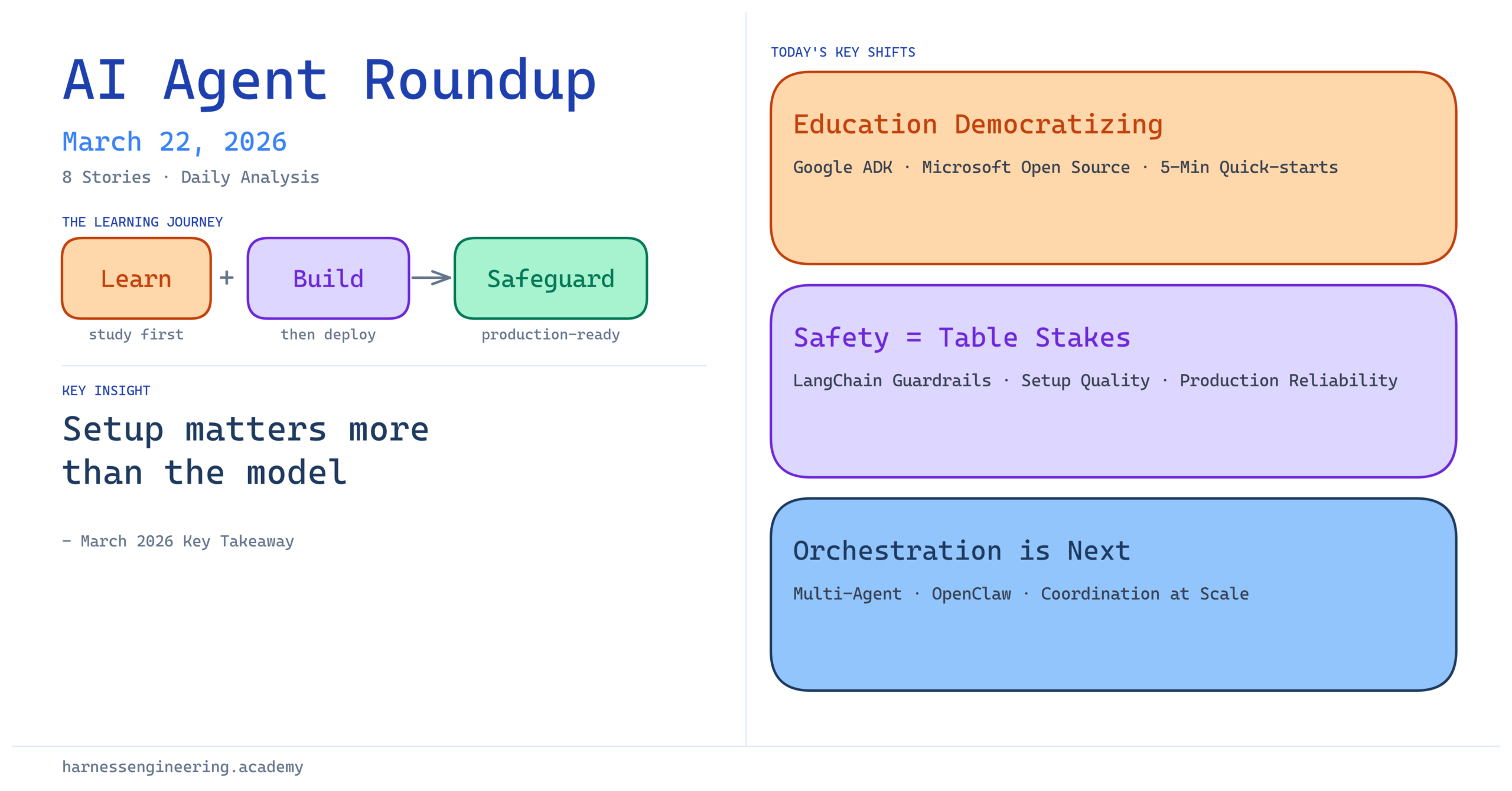
March 22, 2026 shows us an AI agent ecosystem in explosive growth mode, with education, frameworks, and best practices maturing rapidly. Three patterns stand out:
1. Education is democratizing: From Microsoft’s open curriculum to Google’s ADK and YouTube quick-starts, the barrier to learning agentic AI is collapsing. This suggests we’re entering a phase where agent development competency becomes more broadly distributed across the developer population.
2. Safety and reliability are becoming table-stakes: The emphasis on guardrails and setup quality indicates that the field is moving past novelty toward production maturity. Organizations deploying agents now must invest in engineering discipline, not just model capability.
3. Orchestration is the next frontier: Multi-agent systems are where the real value emerges, yet most developers are still building single-agent applications. The next wave of innovation will likely focus on making multi-agent coordination more accessible and reliable.
For practitioners, the message is clear: start learning now with the accessible resources available, focus on engineering fundamentals over model chasing, and prepare for a future where agent orchestration becomes standard practice.
Stay tuned to Harness Engineering Academy for more daily updates on the evolving AI agent landscape.