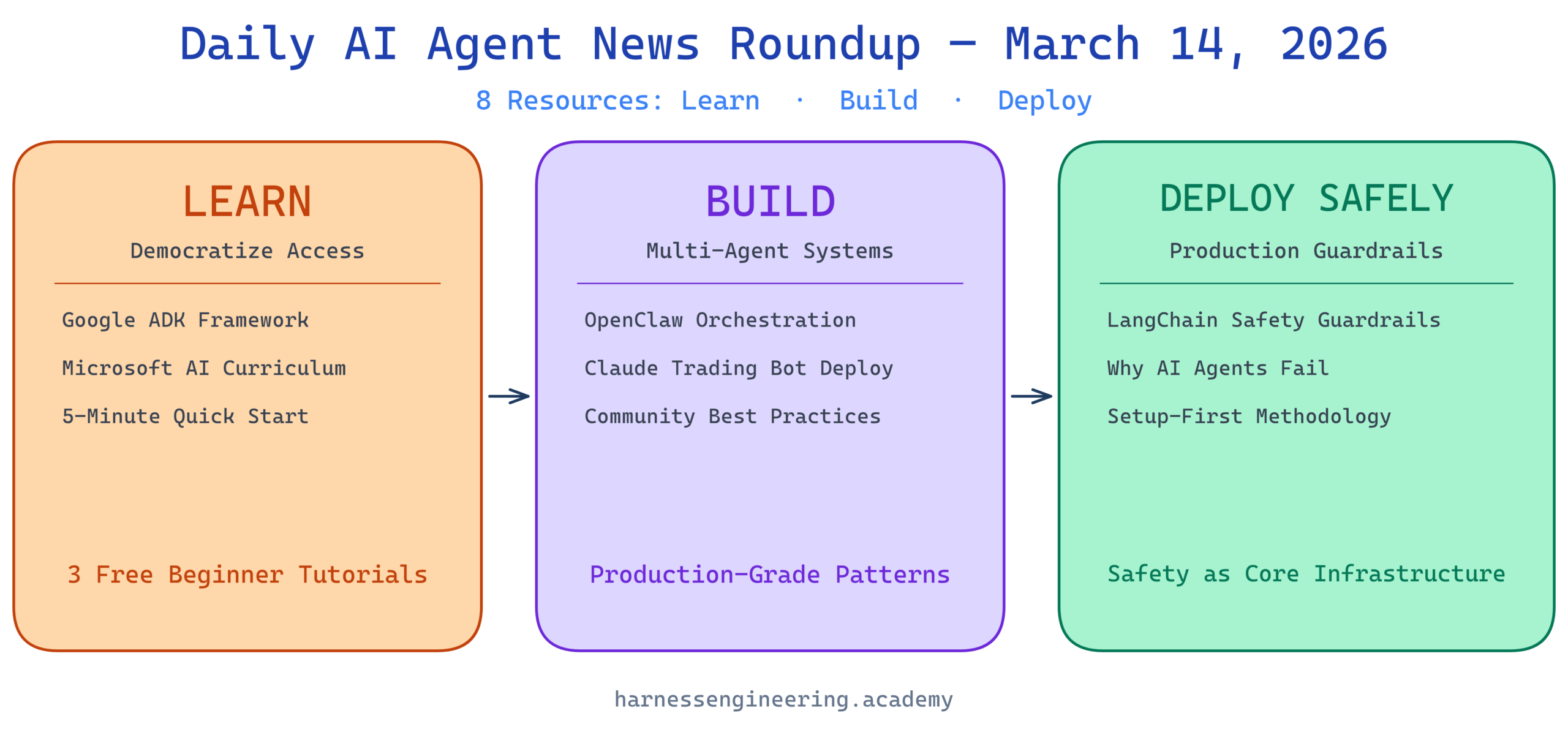
The AI agents landscape continues to accelerate as development frameworks mature and educational resources proliferate. From Google’s comprehensive ADK framework to Microsoft’s beginner-friendly curriculum, developers now have unprecedented access to tools and knowledge needed to build autonomous systems. Today’s roundup highlights critical trends: the democratization of agent development through accessible tutorials, the rise of multi-agent orchestration patterns, and an increasing focus on safety guardrails as these systems move toward production deployment.
1. Google ADK Tutorial: Build AI Agents & Workflows from Scratch (Beginner to Advanced)
Google’s release of the Agent Development Kit (ADK) provides a comprehensive, structured framework for building AI agents from foundational concepts through advanced orchestration patterns. This tutorial spans the complete spectrum, making it accessible to beginners while offering depth for experienced developers looking to implement sophisticated agentic workflows. The ADK positions itself as essential infrastructure for developers who need production-ready tools rather than experimental toy frameworks.
Analysis: Google’s entry into formal agent development education signals the maturation of the field. By providing both tutorial and framework simultaneously, they’re removing friction from the learn-to-build pathway. This comprehensive approach addresses a critical gap where developers could understand concepts theoretically but struggled with practical implementation. The emphasis on workflows—not just individual agents—suggests Google is pushing the industry toward more complex, real-world use cases.
2. Microsoft’s AI Agents for Beginners
Microsoft’s open-source educational repository provides structured, progressive lessons designed specifically for newcomers to agentic AI. The lessons break down complex agent concepts into digestible modules, with practical code examples and clear progression paths. This resource aligns directly with the explosive demand for agent-building knowledge from developers across all skill levels.
Analysis: The timing of Microsoft’s beginner curriculum is strategic—as organizations rush to incorporate AI agents into operations, there’s an acute shortage of developers with practical agent-building experience. By providing free, open-source education, Microsoft both builds community goodwill and creates a pipeline of developers who will naturally gravitate toward Microsoft’s agent frameworks and Azure infrastructure. This represents a larger trend where major cloud providers view developer education as essential competitive positioning.
3. Build Your First AI Agent in 5 Minutes | Agentic AI Course | Python Project
This quick-start guide promises rapid onboarding to agent development with a 5-minute timeline for building a functional AI agent in Python. The emphasis on speed and immediate results addresses a key barrier for developers—the perception that agent development is complex and time-consuming. By demonstrating that basic agent functionality can be achieved quickly, this tutorial potentially converts skeptics into practitioners.
Analysis: The 5-minute framework appeals to two audiences: decision-makers who need proof of concept and developers suffering from tutorial fatigue. In a crowded educational space, the ability to demonstrate working agent code in minimal time is a powerful differentiator. However, viewers should understand this represents the absolute minimum viable agent—production systems will require significantly more architectural consideration. The real value lies in demystification and reducing initial friction.
4. Deploy Your Own AI Agent Trading Bot Using Claude Full Tutorial
A comprehensive tutorial on building and deploying an autonomous trading bot powered by Claude demonstrates practical, real-world agent applications in a domain with immediate financial incentives. The guide likely covers API integration, market data handling, risk management, and deployment infrastructure—addressing the gap between building simple agents and deploying systems that manage real assets. Trading bots represent one of the most demanding use cases for agent reliability and decision quality.
Analysis: The proliferation of trading bot tutorials reflects both opportunity and risk. On one hand, this domain provides strong motivation for developers to master agent development and showcases tangible ROI. On the other hand, the real-money nature of trading creates unique risks—poorly designed agents or flawed market strategies can result in significant losses. The focus on “full tutorial” suggests this guide attempts to address safety considerations, but developers building trading agents should independently verify risk management approaches before deploying capital.
5. Multi Agent Orchestration with OpenClaw
This tutorial introduces OpenClaw, a framework specifically designed for coordinating multiple AI agents working toward shared objectives. Multi-agent orchestration represents a significant leap in complexity from single-agent systems, requiring mechanisms for agent communication, task decomposition, conflict resolution, and result aggregation. OpenClaw appears to abstract these complexities into manageable patterns.
Analysis: Single-agent systems are hitting architectural limits for complex problems—many real-world challenges benefit from specialization (different agents with different capabilities), parallel execution, and hierarchical coordination. The emergence of dedicated orchestration frameworks signals the field’s maturation toward practical multi-agent applications. Organizations should expect that many production AI agent deployments will involve orchestrated multi-agent systems rather than monolithic single agents. This represents a crucial inflection point where agent architectures become noticeably more sophisticated.
6. Learning and Building AI Agents – Reddit Discussion
A community discussion exploring practical roadmaps for learning agent development and building scalable systems using large language models and tool-calling workflows. These organic community conversations often reveal real pain points, common misconceptions, and emerging best practices before they’re formalized in official documentation. The participation of experienced developers provides unfiltered perspectives on what actually works in production scenarios.
Analysis: Community discussions are invaluable for understanding the practitioner perspective—what tutorials gloss over, what documentation assumes incorrectly, and where the biggest knowledge gaps exist. The focus on tool-calling workflows and LLM-based agents reflects the dominant architectural pattern emerging across the industry. For developers uncertain about starting points, these authentic community conversations often provide more trustworthy guidance than polished marketing materials.
7. Guardrails with LangChain 🚀 Build Safe AI Agents Like a Pro
A crash course specifically dedicated to implementing safety guardrails in AI agents using LangChain as a framework. As agents move from experiments to production systems handling real consequences, safety mechanisms become non-negotiable. This tutorial addresses critical implementation questions: How do you prevent agents from taking harmful actions? How do you enforce boundaries on agent behavior? How do you validate outputs before they affect real systems?
Analysis: The explicit focus on safety represents a maturation milestone. Early-stage agent development largely ignored safety considerations, but production deployments require robust guardrails. The use of LangChain suggests frameworks are evolving beyond pure orchestration to include safety-as-a-feature. Organizations deploying agents should view guardrails not as optional nice-to-haves but as core infrastructure. This tutorial’s timing is critical—safety practices should be embedded from the beginning of agent development, not retrofitted later.
8. Why AI Agent Projects Fail: The Setup Problem
This analysis examines why many AI agent projects fail despite access to capable language models, attributing failures primarily to poor foundational setup rather than model limitations. The insight—that model quality is less often the bottleneck than architectural and infrastructural decisions—is crucial for avoiding common pitfalls. This tutorial distills lessons from failed projects into preventative guidance.
Analysis: This perspective is particularly valuable because it shifts focus from chasing better models to improving fundamentals: proper problem decomposition, appropriate tool design, robust error handling, and realistic testing in production-like conditions. Many developers underestimate setup complexity, imagining that capable models automatically produce capable agents. In reality, agent success depends heavily on scaffolding decisions made before the first model call. This tutorial likely provides a reality check that prevents wasted effort on doomed approaches.
Key Takeaways
Three clear trends emerge from today’s news:
Democratization of Access: Between Google’s ADK, Microsoft’s curriculum, and numerous YouTube tutorials, the barrier to learning agent development has collapsed. Developers of any skill level can now find a learning path suited to their starting point.
Production Maturity: The shift from experimental tutorials to safety guardrails, orchestration frameworks, and deployment strategies indicates the field is moving beyond “proof of concept” into production-ready systems. Developers should adopt production mindsets early.
Specialization and Complexity: The progression from single agents to multi-agent orchestration and sophisticated guardrails suggests real-world problems require increasingly sophisticated solutions. Simple agent tutorials are valuable starting points, but teams should plan for architectural complexity as they scale.
For developers in the harnessengineering community, today’s resources—particularly Google’s comprehensive ADK and Microsoft’s structured curriculum—provide excellent entry points. For those already building agents, the focus on safety guardrails and orchestration patterns offers paths to production-ready systems.
This roundup reflects resources published and discussed on March 14, 2026. All links verified at time of publication.