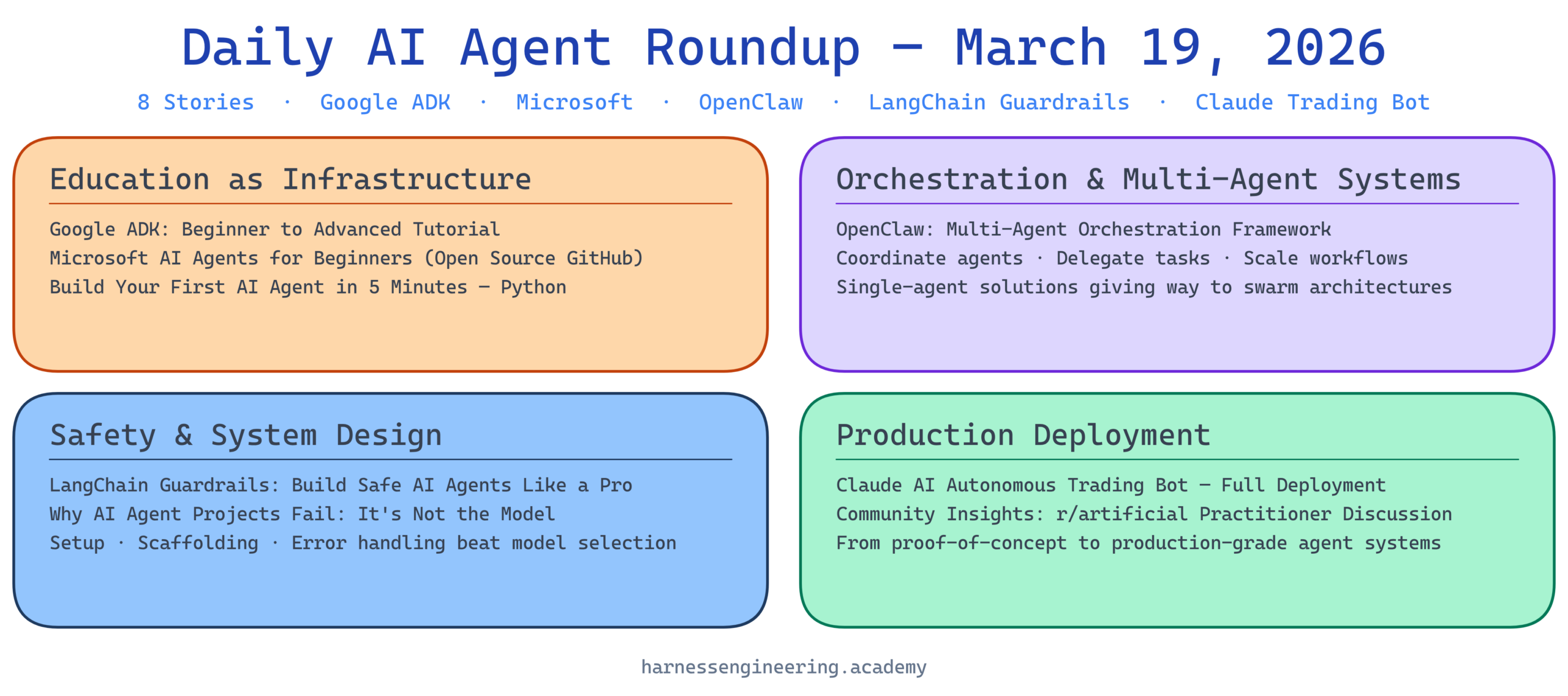
The AI agent landscape is evolving at a rapid pace, and today’s news cycle reflects the critical intersection of education, tooling, and practical deployment. As enterprises and developers race to build intelligent autonomous systems, we’re seeing a surge in accessible learning resources, framework releases, and real-world implementations that are democratizing AI agent development. Here’s what you need to know today.
1. Google ADK Tutorial: Build AI Agents & Workflows from Scratch (Beginner to Advanced)
Google’s latest ADK (Agent Development Kit) tutorial demonstrates a comprehensive framework for building AI agents from foundational concepts through advanced implementations. This end-to-end guide is particularly valuable because it bridges the gap between theoretical understanding and practical application, providing developers with the tooling and architectural patterns necessary to harness AI capabilities effectively.
Analysis: The release of Google’s ADK represents a significant move toward standardizing agent development practices. For developers evaluating frameworks, this comprehensive tutorial reduces adoption friction and signals Google’s commitment to the agent space. The structured progression from beginner to advanced levels means teams of all skill levels can accelerate their development cycles using proven patterns.
2. microsoft/ai-agents-for-beginners
Microsoft’s beginner-friendly repository on GitHub provides structured lessons and hands-on exercises for entering the AI agent field. The open-source approach makes this resource accessible to the entire developer community, democratizing knowledge that was previously siloed within enterprise teams.
Analysis: As AI agents move from experimental projects to mainstream development, educational resources like Microsoft’s become critical infrastructure. The GitHub-based format enables community contributions and rapid iteration, making this less a static tutorial and more a living resource that evolves with industry practices. This represents Microsoft’s strategic positioning in the emerging agent ecosystem.
3. Build Your First AI Agent in 5 Minutes | Agentic AI Course | Python project
This rapid-prototyping guide focuses on time-to-first-success, enabling developers to build a functional AI agent in just five minutes. The Python-first approach aligns with the language’s dominance in AI development and lowers barriers to entry for developers exploring agentic capabilities.
Analysis: The emphasis on quick wins is strategically important for adoption. When developers can experience success immediately, they’re more likely to invest deeper learning and exploration. This short-form content serves as a gateway drug to more complex agent architectures, making it valuable for both platforms seeking engagement and learners seeking quick validation of concepts.
4. Deploy Your Own AI Agent Trading Bot Using Claude Full Tutorial
This comprehensive tutorial guides developers through building and deploying an autonomous trading bot powered by Claude. The trading domain represents one of the highest-value applications for AI agents, where autonomous decision-making can directly impact financial returns.
Analysis: Trading bots represent the “show me the money” application for AI agents, making this tutorial particularly compelling to developers evaluating ROI. The use of Claude indicates the maturity of large language models for financial decision-making, though the critical takeaway is that autonomous trading systems require robust oversight, risk management, and compliance considerations. This tutorial’s value extends beyond trading—the deployment patterns and best practices are applicable across autonomous systems in regulated industries.
5. Multi Agent Orchestration with OpenClaw
OpenClaw’s orchestration framework addresses one of the hardest problems in distributed AI systems: coordinating multiple agents to work toward common objectives. This tutorial tackles the architectural challenge of multi-agent systems where individual agents must communicate, negotiate, and cooperate effectively.
Analysis: As AI agents move beyond single-purpose implementations to complex workflows, orchestration becomes critical. The multi-agent systems space is where simplistic agent tutorials fall short—real production systems require sophisticated coordination mechanisms. OpenClaw’s emergence suggests this gap is being addressed, and developers building enterprise solutions should pay close attention to how orchestration frameworks evolve. This is where the rubber meets the road for scaling agent deployments.
6. Learning and building AI agents (Reddit Discussion)
This Reddit conversation captures real developer experiences and questions about entering the AI agent field. Community discussions like these provide unvarnished perspectives on what works, what doesn’t, and what best practices are emerging from practical experience.
Analysis: Community-driven content is often more valuable than top-down guidance because it reflects ground truth. The fact that developers are actively seeking roadmaps for building scalable AI agents indicates healthy market momentum. These discussions typically surface the messy reality of production deployments—the integration challenges, tool selection decisions, and architectural tradeoffs that tutorials often gloss over. Monitor these conversations to stay grounded in practitioner reality.
7. Guardrails with LangChain 🚀 Build Safe AI Agents Like a Pro
This crash course specifically addresses safety and guardrails implementation in AI agents using LangChain. As autonomous systems gain authority to take action in consequential domains, building safety mechanisms directly into agent architecture becomes non-negotiable.
Analysis: The timing of guardrails-focused content is significant. Early adopters are discovering that unrestricted AI agents create compliance, safety, and liability issues. This tutorial represents the maturation of the field from “can we build it?” to “how do we build it safely?” Organizations deploying agents in production should treat guardrails not as optional polish but as foundational architecture. LangChain’s adoption as the guardrails framework indicates it’s becoming the industry standard for this critical function.
8. Why AI Agent Projects Fail: It’s Not the Model
This insightful analysis shifts focus from model selection to system design and implementation practices. The core insight—that most AI agent failures stem from poor architectural setup rather than model limitations—challenges the industry’s model-centric narrative.
Analysis: This is perhaps the most important perspective in today’s roundup. In an industry obsessed with model capabilities (GPT-4, Claude, etc.), this analysis redirects attention to the harder, often-overlooked problem: building systems around those models that actually work. Success factors include tool integration quality, prompt engineering discipline, error handling, state management, and monitoring—areas where frameworks and best practices are still solidifying. Teams should invest heavily in their agent “scaffolding” before chasing the latest model release.
What This Means Today
The convergence of these items reveals several important trends:
Education as infrastructure: Google, Microsoft, and independent creators are collectively building the educational foundation for widespread agent adoption. This parallels the mobile and cloud eras—when new computing paradigms emerge, education becomes a gating factor.
Practical deployment is maturing: The shift from “how to build agents” to “how to deploy, orchestrate, and secure agents” indicates we’re past the hype cycle’s inflection point and into the implementation phase. This is when real business value gets created or lost.
The setup matters more than the model: The repeated emphasis on architecture, guardrails, and orchestration suggests that competitive advantage will accrue to organizations that master system design, not just model selection.
Multi-agent systems are becoming critical: The rise of orchestration frameworks indicates that single-agent solutions are giving way to sophisticated multi-agent architectures for complex problems.
Key Takeaway
Today’s news cycle tells a coherent story: AI agents are transitioning from experimental proof-of-concepts to production systems. The learning resources reflect this maturity, addressing not just “how to build” but “how to build correctly.” For developers and organizations evaluating the agent space, the message is clear—invest in foundational understanding of framework options (Google ADK, LangChain), prioritize safety and guardrails from day one, and understand that your competitive advantage will come from thoughtful system design, not model selection alone.
The agent revolution isn’t coming. It’s here. The question is whether your team has the education, architecture, and operational discipline to capitalize on it.
Harness Engineering Academy curates AI agent news daily to help developers and engineers stay ahead of rapidly evolving technologies. Follow our coverage for updates on frameworks, best practices, and real-world implementations.